Why propane tanks stop at 80%: what heat does to the other 20%
Propane tanks stop near 80% because liquid propane expands as its temperature rises. The exact permitted fill depends on the container type, location, temperature, and applicable code or manufacturer instructions. ASME house tanks commonly use a liquid-level limit, while DOT cylinders use a weight-based filling rule.
Part of our guide on usable gallons and burn hours for each
Propane Facts
- Common house-tank limit
- About 80% of permitted liquid volume
- Portable cylinder basis
- A weight limit based on water capacity
- Cylinder check
- Total weight minus TW equals propane weight
- Main safety reason
- Room for liquid expansion as temperature rises
- Useful references
- NFPA 58, container markings, and current manufacturer instructions
Contents11 sections
- Why do propane tanks only get filled to 80%?
- How does warm weather affect propane inside the tank?
- What happens when propane has too little vapor space?
- How do weight, the OPD valve and the liquid level gauge stop a fill?
- How is a cylinder's fill calculated by weight?
- What does the triangular OPD handwheel do?
- How does a house-tank gauge control filling?
- How can you tell a properly filled cylinder from a shorted one?
- What should you do if a cylinder was overfilled or became hot?
- Key points
- People also ask
Why do propane tanks only get filled to 80%?
Propane tanks stop near 80% because liquid propane expands as it warms. A liquid-full container has little room for that change, so warming can raise pressure sharply.
The remaining space contains propane vapor. It gives expanding liquid somewhere to go during normal temperature changes. Some liquid also becomes vapor whenever the tank supplies an appliance.
The rule is a safety limit, not a way to sell less fuel. NFPA 58, Liquefied Petroleum Gas Code, contains filling-density rules, but the correct limit depends on the container, installation, temperature, and code edition adopted where you live.
ASME house tanks commonly use a fixed liquid-level gauge. A reading near 80 after delivery usually means the driver reached the tank's permitted level. Check the data plate and supplier records if the reading seems unusual. We cover do propane tanks expire in its own article.
How does warm weather affect propane inside the tank?
Liquid propane takes up more space as its temperature rises. The amount of propane does not increase, but its liquid volume changes.
The change depends on the liquid temperature, not simply the outdoor air temperature. Sun, tank color, wind, soil, insulation, and whether the tank sits above or below ground all affect the container.
The vapor space provides room for this expansion. A tank filled beyond its permitted liquid level has less room available, so its pressure can rise more quickly during heating. Before you commit to anything, it is worth looking at what frost on tanks means.
PERC publishes propane property information, including temperature and density data, in its [Propane Properties and Safety Data](https://propane.com/resource/propane-properties-and-safety-data/) material. Use the document's stated temperature, composition, and density assumptions before calculating a volume change. Do not treat a general expansion estimate as a fill allowance.
What happens when propane has too little vapor space?
A container with vapor space generally shows pressure related to liquid temperature and propane composition. Pressure can rise as the liquid and container warm.
A liquid-full container behaves differently. Liquid compresses very little, so warming leaves expansion with nowhere to go. The pressure can become dangerous before the container looks different from the outside. People in this spot often ask about how to check propane tank level as well.
Relief valves protect containers from excessive pressure, but they are not a substitute for the correct fill level. A valve can discharge propane vapor or liquid. Released liquid quickly becomes a much larger volume of gas.
Relief-valve settings vary by container, valve model, service, and manufacturer. Check the marking on the valve and the container manufacturer's documentation. Never assume a setting from another tank or cylinder applies to yours.
Use the pressure and relief-valve information only for your own equipment. A household gauge does not show enough detail to diagnose a pressure problem. It helps to understand propane tank recertification before going further.
How do weight, the OPD valve and the liquid level gauge stop a fill?
Different containers use different fill controls. Portable DOT cylinders are commonly filled by weight, while ASME tanks use a fixed liquid-level gauge or other approved filling method. An OPD can provide overfill protection on many portable cylinders.
The exact permitted fill depends on container type, service, location, temperature, and the applicable code edition. The container label, data plate, valve marking, and supplier instructions take priority over a generic percentage.
How is a cylinder's fill calculated by weight?
A portable cylinder's fill is based on water capacity and propane weight, not its nickname. Under common propane filling rules, the permitted propane mass is calculated as a percentage of the cylinder's water capacity. The percentage and method must match the applicable code and cylinder specification. Before you commit to anything, it is worth looking at does a 20 lb propane tank last.
This rule differs from the roughly 80% liquid-volume reading on an ASME house tank. The two percentages measure different things. Do not compare them as if they describe the same fill.
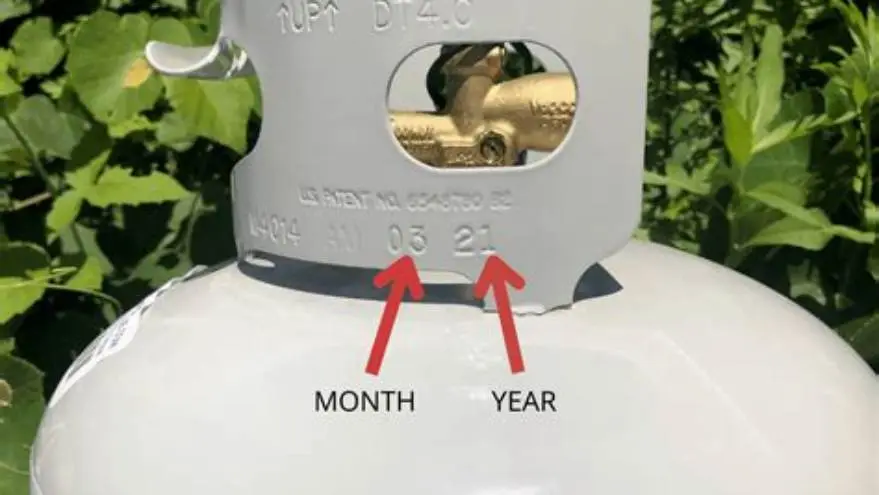
Read the stamped TW value on the collar. Weigh the cylinder without a hose attached, then subtract TW from the total weight. Compare the result with the fill amount printed on the cylinder or exchange label.
A cylinder marked for a particular fill can have a different tare weight from another cylinder of the same nominal size. The label and stamped markings are the useful references. There is more on underground propane tank problems in a separate guide.
What does the triangular OPD handwheel do?
An OPD, or overfill prevention device, uses a float inside the cylinder valve. The float closes the filling path when liquid reaches the valve's designed level. A triangular handwheel often identifies an OPD valve.
The exact OPD requirement depends on cylinder construction, service, capacity, and the code edition in force. Check the valve marking and ask a qualified cylinder shop or supplier when the requirement is unclear.
An older round handwheel does not by itself prove a cylinder is unsafe or approved. DOT requalification, valve condition, cylinder markings, and intended service all matter. Never replace the valve yourself. It helps to understand propane tank lease vs own before going further.
How does a house-tank gauge control filling?
A delivery driver uses the tank's fixed liquid-level gauge to stop filling at the permitted level. The dial then gives you an approximate indication of liquid volume.
Above-ground and underground installations can have different requirements. The tank data plate, manufacturer instructions, local rules, and adopted code edition determine the permitted fill for that installation.
A house-tank gauge is not the same measurement as cylinder weight. Read it as an operating indication, not as proof of an exact percentage.
How can you tell a properly filled cylinder from a shorted one?
A suitable hanging scale gives you the clearest home check for a portable cylinder. Choose one rated above the cylinder's complete weight, with an accuracy specification appropriate for the difference you need to detect. Follow the scale maker's instructions and inspect the hook before lifting.
Suppose a cylinder shows TW 17.0 and weighs 33.5 pounds. Subtracting gives 16.5 pounds of propane. Compare that result with the fill amount printed on the cylinder label.
Small differences can come from scale accuracy, hose attachments, temperature, or rounding. Ask the filler to recheck a result outside the label's stated amount. Don't vent propane or adjust the valve at home.
Exchange cylinders can carry a fill amount different from a refillable cylinder. Read the current label rather than assuming every cylinder holds the same amount. The label controls your comparison.
- Read the cylinder's TW mark and fill label.
- Remove the hose and weigh the upright cylinder with a suitable scale.
- Subtract TW from the total weight.
- Compare the propane weight with the labeled fill amount.
- Ask the filler to recheck a result outside the expected range.
What should you do if a cylinder was overfilled or became hot?
Keep a suspected overfilled cylinder upright outdoors, shaded, and away from flames, sparks, drains, doors, and windows. Do not vent it, tip it, open the valve, or put it in water.
For a nonleaking suspected overfill, contact the filler or supplier before using or transporting the cylinder. Give them the cylinder label, measured weight, and any heat exposure. They can choose a safe handling method.
A propane odor, hissing sound, frost, or white vapor can indicate a leak. Move people away without operating switches, vehicles, valves, or other ignition sources near the cylinder.
Leave the affected area and call the supplier or 911 from a safe location. Do not return until qualified personnel say it is safe.
- Keep a suspected overfill upright, shaded, and away from ignition sources.
- Never vent propane or operate a questionable valve at home.
- Use the container label and supplier instructions when arranging service.
- Treat odor, hissing, frost, or white vapor as a possible leak.
- Move people away if you can do so without approaching the hazard.
- Leave the area if you smell gas or hear escaping gas.
- Call the supplier or 911 from a safe location.
- For a nonleaking weight concern, contact the filler before using or moving the cylinder.
Key points
- Read a cylinder's TW mark and compare it with the total scale weight.
- A house-tank gauge near 80 after delivery usually indicates a normal fill.
- House tanks use a liquid-level limit. DOT cylinders use water capacity and propane weight.
- Check the container label, data plate, and current supplier instructions before judging a fill.
- Treat propane odors, hissing, frost, or white vapor as leak warnings and leave the area.
People also ask
Why does my tank gauge rise on a hot day?
Liquid propane occupies more volume as its temperature rises, so the approximate gauge reading can rise. The amount of movement depends on the tank and its conditions. Contact the supplier if the reading reaches the marked limit or you see a leak warning.
Can I ask the driver to fill past 80%?
No. The allowed fill comes from the container's approved data, applicable code, and installation conditions. Ask about a larger tank or more frequent deliveries instead.
Can I keep using a cylinder with a round handwheel?
Ask a qualified cylinder shop or supplier to inspect it. DOT requalification, valve type, cylinder condition, and intended service determine whether it remains approved. Never replace the valve yourself.
Why does my exchange cylinder hold less than a refill?
Read the current label. Exchange and refill cylinders can carry different labeled amounts. Use the label, not the cylinder's nickname, when checking its weight.