Propane tank sizes: usable gallons and burn hours for each
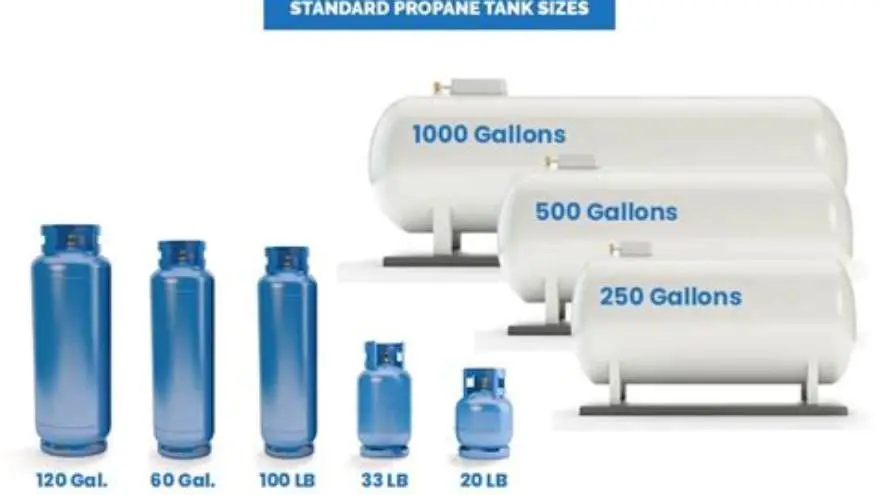
Propane tank sizes run from portable 20 lb cylinders to large bulk tanks. Cylinder labels describe propane by weight, while bulk-tank labels describe nominal water capacity. The propane capacity is lower than the label, and actual runtime depends on duty cycle, temperature, regulator capacity and fill amount.
Propane Facts
- 20 lb cylinder
- about 4.7 gal of propane
- 500 gal tank
- about 400 gal at the normal fill limit
- Energy content
- about 91,500 BTU per gallon
- Propane weight
- about 4.24 lb per gallon
- Liquid to vapor
- about 270 times the liquid volume
- 20 lb example
- about 17 h at 25,000 BTU/h, running nonstop
Contents8 sections
- What are the common propane tank sizes?
- How do water capacity and propane capacity differ?
- How do you convert pounds to gallons and BTU?
- How many hours will a tank last on your appliance?
- How do you read the collar markings and see what's left?
- Which size fits a grill, RV, home or generator?
- Key points
- People also ask
What are the common propane tank sizes?
Cylinders are usually sold by pounds of propane. Common sizes include 20, 30, 40 and 100 lb. Bulk tanks are sold by nominal water capacity, meaning the gallons of water their shells could hold.
The table separates nominal water capacity from propane capacity. Its hour figures are arithmetic examples at a constant appliance input. They are not predictions for cycling furnaces, grills or generators.
A BTU is a unit of heat. BTU/h tells you how fast an appliance can consume fuel. Check the input rating on the appliance data plate before comparing it with these examples.
Tank selection needs more than a label. Consider appliance load, climate, heat loss, delivery frequency, regulator capacity and local supplier requirements. Before you commit to anything, it is worth looking at what 80% vs 96% AFUE means.
| Tank | Nominal water capacity | Propane capacity | Propane weight | 25,000 BTU/h example | 20,000 BTU/h example | 50,000 BTU/h example |
|---|---|---|---|---|---|---|
| 20 lb cylinder | about 5.7 gal | about 4.7 gal | 20 lb | 17 h | 21.5 h | 8.6 h |
| 30 lb cylinder | about 8.5 gal | about 7.1 gal | 30 lb | 26 h | 32.5 h | 13 h |
| 40 lb cylinder | about 11.4 gal | about 9.4 gal | 40 lb | 34 h | 43 h | 17 h |
| 100 lb cylinder | about 28.5 gal | about 23.6 gal | 100 lb | 86 h | 108 h | 43 h |
| 120 gal tank | 120 gal | about 96 gal | about 407 lb | 351 h | 439 h | 176 h |
| 250 gal tank | 250 gal | about 200 gal | about 848 lb | 732 h | 915 h | 366 h |
| 500 gal tank | 500 gal | about 400 gal | about 1,696 lb | 1,464 h | 1,830 h | 732 h |
| 1,000 gal tank | 1,000 gal | about 800 gal | about 3,392 lb | 2,928 h | 3,660 h | 1,464 h |
How do water capacity and propane capacity differ?
The number on a bulk tank is usually nominal water capacity, not propane capacity. Propane needs expansion room, so a normal fill stops at about 80 percent of that volume. A 500 gallon tank therefore holds about 400 gallons of liquid propane at that fill level.
The same distinction applies to cylinders, although cylinders are marketed by propane weight. A 20 lb cylinder has roughly 5.7 gallons of water capacity and holds about 20 lb, or 4.7 gallons, of propane when filled normally.
A house-tank gauge estimates liquid level as a percentage of the tank's water capacity. A reading near 40 on a 500 gallon tank indicates roughly 200 gallons by the gauge's scale. Gauge accuracy varies, so treat the result as an estimate. Before you commit to anything, it is worth looking at gallons a year with heat vs. without heat.
The nameplate gives the tank's capacity. Ask the supplier to confirm the size if the plate is damaged or unreadable.
How do you convert pounds to gallons and BTU?
A gallon of propane weighs about 4.24 lb and contains about 91,500 BTU. Those are planning figures, not laboratory constants. Temperature and propane composition change them slightly.
Liquid propane becomes vapor at the burner. The vapor occupies far more space than the liquid, which is why a small cylinder can supply many hours of heat. It helps to understand vented vs ventless propane heaters before going further.
Use these conversions for your own estimate:
- Pounds to gallons: divide pounds by 4.24. Example: 40 lb ÷ 4.24 equals about 9.4 gallons.
- Gallons to pounds: multiply gallons by 4.24. Example: 100 gallons × 4.24 equals about 424 lb.
- Gallons to BTU: multiply gallons by 91,500. Example: 9.4 gallons contains about 860,000 BTU.
- Pounds to BTU: multiply pounds by about 21,600. Example: 40 lb contains about 864,000 BTU.
- Flat-out hours: divide stored BTU by the appliance input rating.
How many hours will a tank last on your appliance?
Use the flat-out formula only as a starting point: usable gallons × 91,500, divided by appliance input in BTU/h. The result assumes continuous operation at the listed input.
Actual runtime depends on duty cycle, outdoor temperature, regulator capacity and fill amount. A furnace cycles, so its burner rating does not equal its average fuel use. Cold weather can increase demand, while a nearly empty cylinder may struggle to vaporize fuel. People in this spot often ask about how long does a 20 lb propane tank last as well.
Here is a worked example. A 30 lb cylinder contains about 7.1 gallons. At 91,500 BTU per gallon, that stores about 649,650 BTU. An example furnace running 40 percent of the time would average 8,000 BTU/h from a 20,000 BTU/h input rating, giving about 81 arithmetic hours.
That 40 percent duty cycle is an example, not a typical fact. Measure your own usage from tank weight or refill amounts across several cold days. A regulator or cylinder can also limit delivery before the calculated fuel is gone.
A patio heater rated at 40,000 BTU/h is another example figure. If it ran nonstop on a 20 lb cylinder, the arithmetic result would be about 11 hours. Check the rating on your heater. People in this spot often ask about about 21,600 BTU divided by burner BTU/hr as well.
- 30 lb ÷ 4.24 equals about 7.1 gallons.
- 7.1 gallons × 91,500 equals about 649,650 BTU.
- 20,000 BTU/h × 0.40 equals an example average draw of 8,000 BTU/h.
- 649,650 ÷ 8,000 equals about 81 hours.
- At nonstop input, 649,650 ÷ 20,000 equals about 32 hours.
How do you read the collar markings and see what's left?
Find the collar around a portable cylinder's valve. TW means tare weight, or the empty cylinder's weight. WC means water capacity, usually marked in pounds. The manufacture date appears nearby, though layouts vary.
DOT cylinders generally need requalification 12 years after manufacture. Later intervals depend on the method and inspection marking. Some requalified cylinders have a five-year interval, while others qualify for longer intervals under the applicable DOT rules. Read the requalification mark and ask the supplier before filling or exchanging one.
A supplier or exchange site may refuse a cylinder that is out of requalification, damaged, corroded or otherwise unacceptable. Policies differ, so check with the supplier before carrying a questionable cylinder there. There is more on check propane tank level in a separate guide.
Weigh the cylinder and subtract TW to estimate propane weight. A bathroom scale can work for smaller cylinders. Use a suitable hanging or platform scale if lifting the cylinder is unsafe, and follow its instructions.
Bulk tanks have no TW collar for household measuring. Read the nameplate for water capacity and the gauge for an approximate liquid level.
- Turn the appliance off and disconnect the cylinder outdoors, away from flames.
- Read TW from the collar and record it. Example: 17.0 lb.
- Weigh the cylinder. Example: 28.5 lb.
- Subtract: 28.5 minus 17.0 equals 11.5 lb of propane.
- Divide 11.5 by 4.24 for about 2.7 gallons, then compare it with your appliance load.
Which size fits a grill, RV, home or generator?
Choose a tank from the appliance load, climate, heat loss and refill plan. Local suppliers may require a particular tank size, regulator, setback or delivery arrangement. Ask before buying or installing a bulk tank. For the detail, see our notes on why do propane tanks only get filled to 80%.
A grill often uses a 20 lb cylinder, but its actual consumption depends on burner settings and cooking time. Keep a spare only if local storage rules allow it.
RV systems may use 20 or 30 lb cylinders, or a built-in tank. Check the RV plate, regulator and connection before changing sizes. A larger cylinder can help in cold conditions, but it must suit the system.
Home-heating tank categories are not reliable recommendations. A heating system needs a heat-load estimate, climate data, heat-loss calculation and supplier-delivery plan. Tank size also depends on other appliances and the vaporization capacity of the installation.
A generator needs its own fuel-consumption data at the loads you expect. Example: a generator using 3 gallons per hour at full load would use about 200 gallons in 67 hours from a 250 gallon tank's stated usable capacity. Actual use changes with electrical load and temperature.
Keep cylinders outdoors and upright. Follow local code for clearances, regulators, buried tanks and appliance ventilation. Never bring a cylinder into a house, garage, tent or camper cabin.
- Grill: check the appliance input and cooking pattern before choosing a cylinder.
- RV: confirm cylinder type, connection, regulator capacity and storage rules.
- Home heating: obtain a heat-load estimate and supplier-delivery plan.
- Generator: use the manufacturer's fuel-use figures at expected electrical loads.
Key points
- Read TW on a cylinder collar, then subtract it from the total weight.
- Use appliance input ratings for flat-out arithmetic, not a promise of runtime.
- A house-tank gauge shows approximate liquid level as a percentage of water capacity.
- Cold weather and regulator limits can stop vapor delivery before the tank is empty.
- Keep cylinders outdoors and upright, never in a house, garage or tent.
People also ask
Why can't a cylinder be filled to the top?
Liquid propane needs expansion room. The overfill prevention device and filling procedure limit the amount. Never ask someone to bypass that protection.
When should I order a refill for a house tank?
Ask your supplier for its reorder point. The right level depends on delivery time, weather, tank size and your fuel use.
Can I put a bigger cylinder on an appliance made for a 20 lb one?
Only if the connection, regulator, appliance instructions and local rules permit it. A larger cylinder does not remove regulator or vaporization limits.
Does a gauge reading of 80 mean my tank is overfilled?
Not usually. Many house gauges show about 80 when the tank reaches its normal fill level. Ask the supplier if the reading looks unusual.