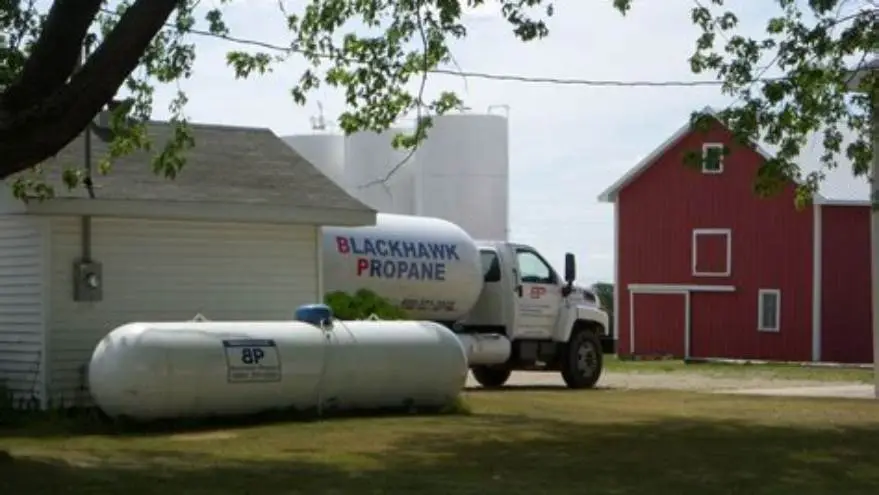
House propane use: gallons a year with heat vs. without heat
How much propane does a house use? Appliance-only homes use far less than propane-heated homes, while space heating can multiply annual consumption. Your total depends on appliance use, weather, house heat loss, furnace efficiency, and whether domestic hot water shares the same tank.
Propane Facts
- Without heat
- appliance use only: estimate from nameplates
- With heat
- appliance use plus heating use: estimate separately
- Tank water heater
- estimate from input rating and runtime
- Heat per square foot
- 0.15-0.90 gal/year depending on HDD and AFUE
- Energy per gallon
- about 91,500 BTU
- Furnace at 80,000 BTU/h input, 80% AFUE
- about 0.87 gal/hour at full fire
- Full 500 gal tank
- reads 80 on the gauge, holds about 400 gal
Contents9 sections
- How much propane does a house use in a year?
- How much propane do a water heater, range, dryer and fireplace burn?
- How do climate and house size change the heating figure?
- How do you work out your own number from delivery tickets or gauge readings?
- Why does a full tank read 80 and not 100?
- How do you turn gallons into BTU and a monthly cost?
- What tank size and delivery schedule does that number imply?
- Key points
- People also ask
How much propane does a house use in a year?
The question almost always mixes two separate things. Appliance use covers the water heater, range and dryer. Heating use covers the furnace or boiler. They respond to completely different factors, so this article keeps them separate from start to finish.
Appliance use follows how many people live in the house and how they cook, shower and do laundry. Heating use follows winter weather, square footage and how well the walls are insulated. A single national average blends both and fits almost nobody.
The EIA Residential Energy Consumption Survey (RECS) is the most cited source for household propane use in the United States. It publishes figures by region and end use, and it is the right starting point if you want a published benchmark. Your own delivery tickets, though, will always be more accurate than any survey average.
How much propane do a water heater, range, dryer and fireplace burn?
Start with the water heater, the biggest appliance load. Find the input rating on the nameplate, usually in BTU per hour. Divide that number by 91,500 to get gallons per hour at full fire. Multiply by your estimated hours of operation per year to reach an annual figure. That method works for every gas appliance in the house. We go through farm propane step by step elsewhere on the site.
A tankless water heater may reduce fuel use compared with a storage tank model under some usage patterns, because it does not keep a stored volume of water hot. Whether it does in your home depends on how you draw hot water: short, frequent draws close the gap; long, infrequent ones widen it. Check the input rating on the nameplate and use the same calculation.
Generators need a caution. A standby unit sits outdoors on a pad, and a portable one never runs indoors or in a garage, because of carbon monoxide. Burn rates vary widely by size and load. Read the fuel consumption chart in your model's manual for the only reliable figure.
For any appliance, divide its nameplate BTU input rating by 91,500 for gallons per hour at full fire, then multiply by estimated hours of use. That is the method. The table below shows the variables that move the answer for each appliance type. We go through propane tank sizes step by step elsewhere on the site.
| Appliance | How to estimate use | What moves it |
|---|---|---|
| Tank water heater | Nameplate BTU/h ÷ 91,500 × estimated hours/year | Household size, incoming water temperature, tank insulation |
| Range and oven | Nameplate BTU/h ÷ 91,500 × estimated cooking hours | How much you cook; burner size varies widely |
| Gas dryer | Nameplate BTU/h ÷ 91,500 × estimated cycle hours | Loads per week; cycle length |
| Fireplace gas logs | Nameplate BTU/h ÷ 91,500 = gal/hour; multiply by hours | Log set size; vented sets run larger than ventless |
| Standby generator | See model's fuel chart for gal/hour at rated load | Generator size, electrical load, outage length and test schedule |
How do climate and house size change the heating figure?
Climate sets the base. Weather services track heating degree days (HDD): for each day, the number of degrees the average temperature falls below 65 F, added up over the year. NOAA publishes 30-year climate normals by station, and many utilities publish the figure for your town. Use your nearest station's HDD to pick a row in the table below.
Square footage scales the heating figure roughly in a straight line, but only roughly. Ceiling height, window area and insulation matter as much as floor area. Use the low end of each range for newer, well-sealed homes and the high end for older ones.
Furnace efficiency moves the number too. AFUE, or annual fuel use efficiency, is the share of fuel input that becomes usable heat. A furnace rated 80% AFUE delivers less heat per gallon than a 95% unit. To adjust: divide 0.95 by your furnace's AFUE decimal. A 0.80 AFUE furnace needs 0.95 ÷ 0.80 = 1.19 times as much fuel as a 95% unit for the same warmth. The nameplate or the manufacturer's spec sheet shows the AFUE rating. People in this spot often ask about propane vs kerosene heater cost as well.
| Climate zone | Approximate HDD (NOAA 30-yr normals) | Gal per sq ft per year | Illustrative 2,000 sq ft house |
|---|---|---|---|
| Mild (e.g. Gulf Coast states) | 1,500-3,500 | 0.15-0.35 | 300-700 gal |
| Moderate (e.g. mid-Atlantic, Midwest transition) | 3,500-5,500 | 0.30-0.60 | 600-1,200 gal |
| Cold (e.g. upper Midwest, northern New England) | 5,500-9,000 | 0.50-0.90 | 1,000-1,800 gal |
How do you work out your own number from delivery tickets or gauge readings?
Your own records beat any table here. You need delivery tickets for 12 months in a row and two gauge readings, one at each end. If a ticket is missing, most suppliers will send a delivery history when you ask. The worked example below uses a 500 gallon tank with a stated set of assumptions.
- Add up the gallons on every ticket in the 12 months. Worked example (500 gal tank, moderate climate): 295 + 290 + 295 = 880 gallons delivered.
- Read the gauge on the first and last day of the 12 months. Multiply each reading by the tank's nameplate capacity. In the example: a 500 gallon tank reading 30 holds 150 gallons; reading 25 holds 125 gallons.
- Work out use: starting gallons plus gallons delivered minus ending gallons. Example: 150 + 880 − 125 = 905 gallons for the year.
- Find base appliance use from a stretch with no heating and no delivery, such as June 1 to September 1. Example: the gauge fell from 48 to 36, a drop of 12 points. Each point equals 5 gallons on a 500 gallon tank, so 60 gallons in 3 months, or 240 gallons annualised.
- Subtract base from total to separate heating. Example: 905 − 240 = 665 gallons of heating use.
Why does a full tank read 80 and not 100?
Many people assume a full tank reads 100. It doesn't. Suppliers fill to about 80% of volume to leave room for the liquid to expand, so a full 500 gallon tank reads 80 and holds about 400 gallons. Convert gauge readings using the tank's nameplate capacity, not 400.
Gauge readings are approximate. Tank geometry, gauge calibration and temperature all affect the reading. Treat any single gauge reading as a rough indicator, not a precise measurement. Use repeated readings combined with your delivery records for a reliable picture.
Cylinders instead of a tank? You have no dial, so weigh them. Use a hanging or platform scale rated above the cylinder's full weight. Subtract the tare weight (TW) stamped on the collar, then divide the remaining pounds by 4.24 to get gallons.
How do you turn gallons into BTU and a monthly cost?
Propane carries about 91,500 BTU per gallon, so gallons convert to heat with one multiplication. Using the worked example of 905 gallons: 905 × 91,500 = about 82.8 million BTU for the year. That is fuel energy in, before furnace and water heater losses.
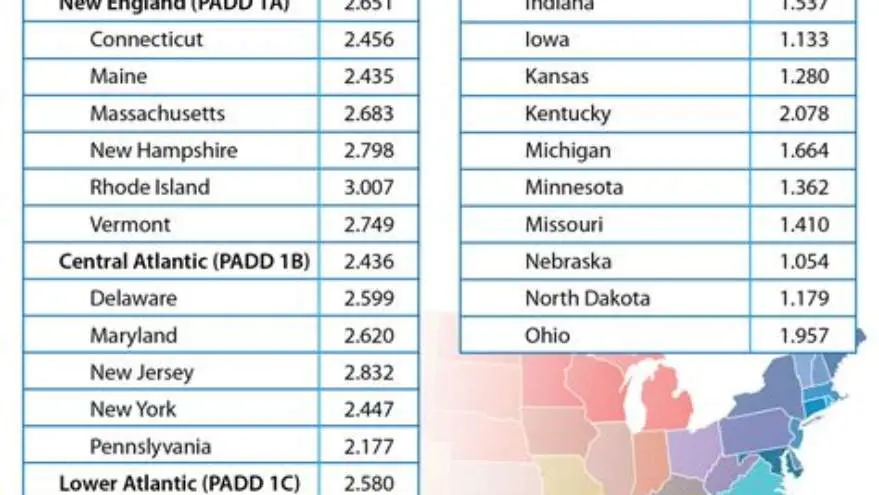
Cost is the part to do with your own bill. As a labeled example only, using $3.00 per gallon: 905 × $3.00 = $2,715 a year, about $226 a month averaged over 12 months. The EIA publishes state-level propane price averages during heating season, but the price on your own bill is the one that counts.
That average hides the shape of the year. A furnace with an 80,000 BTU/h input rating burns 80,000 ÷ 91,500 = 0.87 gallons per hour at full fire. Running at 25% of the time in a cold month, that is about 5.2 gallons a day. A 31-day January on that schedule burns roughly 160 gallons of heating fuel alone. Use the same arithmetic with your furnace's nameplate input rating and your own estimated runtime.
- Gallons to BTU: gallons × 91,500.
- Burn rate: nameplate BTU/h input ÷ 91,500 = gallons per hour at full fire.
- Gallons to kWh equivalent: gallons × 26.8 (from 91,500 ÷ 3,412 BTU per kWh).
- Monthly cost: gallons used × your price per gallon.
What tank size and delivery schedule does that number imply?
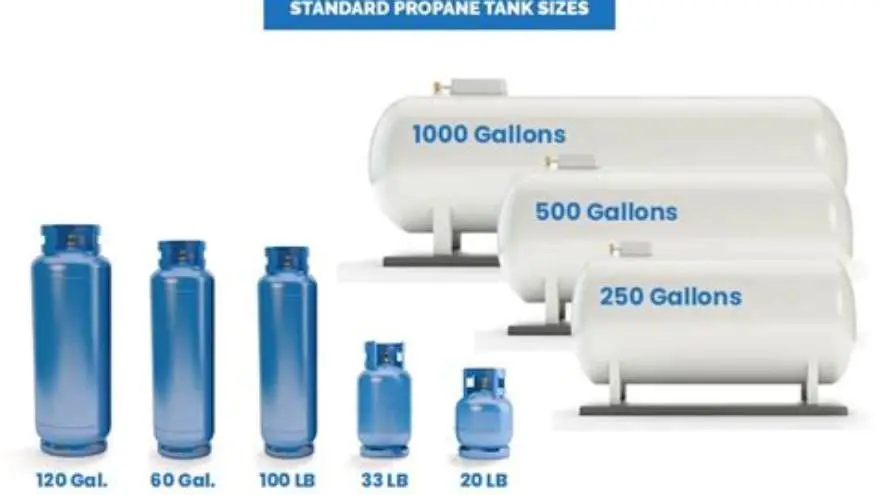
A tank is never emptied or filled to the brim. Suppliers fill to about 80% of volume, and reorder thresholds vary by supplier, weather, tank size and delivery policy. Ask your supplier what level they use as a trigger. The table below uses a fill-to-80% and reorder-at-25% assumption as a worked example; your supplier's actual threshold changes the fill count.
Using the worked example of 905 gallons of annual use and the stated 80%-to-25% fill assumption: a 500 gallon tank yields about 275 gallons per fill, so that house needs roughly three to four fills a year. That is a planning figure based on those stated assumptions, not a general rule.
A hot-water-only house can run a smaller tank and needs fewer deliveries. Ask whether your supplier offers automatic delivery, based on weather estimates, or will-call. If you add a fireplace or a household member, tell the supplier, because automated estimates cannot see those changes. Count the fills on last year's tickets and compare them with the table.
| Annual use (worked example) | 250 gal tank | 500 gal tank | 1,000 gal tank |
|---|---|---|---|
| 300 gal (appliances only) | About 2 | About 1 | Under 1 |
| 905 gal (worked example, moderate climate) | About 7 | About 3-4 | About 1-2 |
| 1,500 gal (cold climate, larger house) | About 10-11 | About 5-6 | About 2-3 |
Key points
- Never use one average. Estimate appliance use and heating use separately, then add them.
- Hot water follows the number of people. Heating follows climate, square footage and insulation.
- Gallons used = starting gallons + gallons delivered - ending gallons. Tickets alone are not enough.
- Cost is gallons times your price per gallon, and January can cost several times what July does.
- A 500 gallon tank gives roughly 275 gallons between an 80% fill and a 25% reorder, depending on your supplier's policy.
People also ask
Does a tankless water heater cut my propane use?
It may, under some usage patterns, because it does not keep a stored volume of water hot between draws. The actual difference depends on how you use hot water. Find the input rating on the tankless unit's nameplate and compare it with your storage heater's rating and estimated runtime. That calculation is more reliable than any general claim.
My use doubled this winter. Is that a leak?
Usually it's colder weather, a new appliance or a stuck thermostat. If you smell gas, leave the area at once. Use no switches, flames or phones inside, call your supplier or 911 from outside, and don't return until a professional says it's safe.
How much propane does a standby generator use in an outage?
Read the fuel consumption chart in your model's manual. Manufacturers publish gallons per hour at different load levels, and generator size and electrical load vary enough that any general figure could be misleading. Check your tank level before a storm so you know your margin.
Will automatic delivery keep me from running out?
Mostly, but it estimates from weather and past use. A new fireplace, a household change or a very cold month can break the estimate, so check your gauge and call early if it falls toward your supplier's reorder level.