Propane tank recertification: cylinder date or ASME tank?
Propane tank recertification depends on the container. A portable DOT cylinder follows requalification rules in current 49 CFR Part 180, with timing tied to its specification and marking. An ASME tank has no cylinder requalification date; check its condition, relief device, supplier requirements, and locally adopted code.

Part of our guide on propane tank sizes
Propane Facts
- First DOT requalification
- See the cylinder-date section below
- Date format
- Month then year, e.g. 05 14
- Next test interval
- Usually 5 to 7 years
- ASME federal interval
- None fixed
- OPD valve needed
- Cylinders 4 to 40 lb
- Normal fill level
- About 80% by volume
Contents8 sections
- How do I tell a DOT cylinder from an ASME tank?
- Where do I find the manufacture date and requalification marks on a cylinder?
- How do the requalification date and an added mark change the next due date?
- What does propane tank recertification mean for an ASME tank?
- Why would a supplier refuse to fill my tank?
- What should I ask a supplier or requalifier if the markings are unreadable?
- Key points
- People also ask
How do I tell a DOT cylinder from an ASME tank?
Propane tank recertification starts with one question: what kind of container is this? Check its label and stamps before you call anyone. The official term is requalification, a periodic test or inspection that shows a container is still safe to fill. Suppliers understand either word.
A DOT cylinder is the portable kind: grill tanks, camp bottles, and upright bottles on many travel trailers. DOT is the US Department of Transportation, which sets rules for containers moved and refilled. Look on the collar, the metal ring around the valve, for a stamp like DOT 4BA240. The last number is the rated pressure in psi.
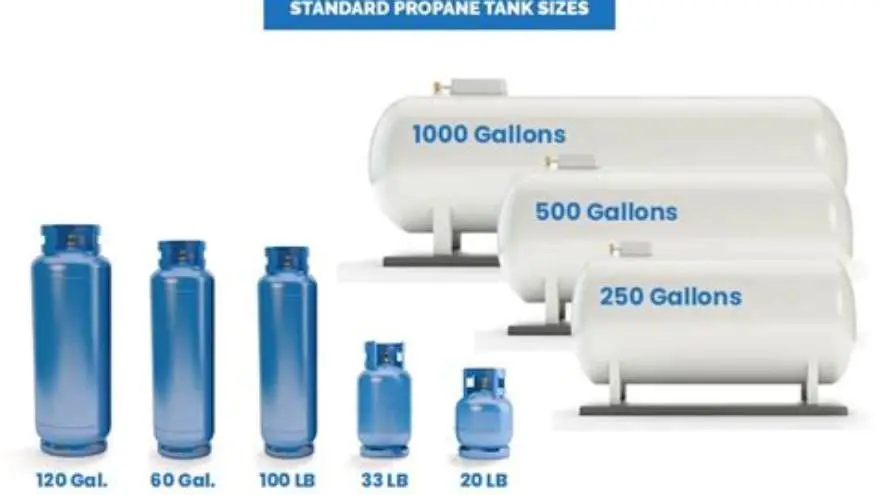
An ASME tank is a pressure vessel built to a code from the American Society of Mechanical Engineers. It commonly carries a metal nameplate near the valve dome. The plate lists the maker, year built, serial number, and design pressure. Home tanks from 100 gallons up fit here, as do many permanently mounted motorhome tanks.
Size alone won't settle it, because small ASME tanks exist. Trust the complete set of markings instead. Take a photo of whichever mark you find before you look up a rule. Before you commit to anything, it is worth looking at propane tank ownership.
| Check | DOT cylinder | ASME tank |
|---|---|---|
| Where the marks are | Stamped into collar or foot ring | Metal nameplate, often near the valve dome |
| Typical examples | Grill tank, RV bottle, forklift cylinder | Home tank, motorhome tank |
| Valve clue | Overfill valve, often a triangular handwheel | Service valve, gauge, relief valve under a dome |
| How it gets filled | Carried to a filler or swapped | Usually filled in place by a truck or station |
| Requalification | Date-based federal rules apply | No fixed federal requalification interval |
Where do I find the manufacture date and requalification marks on a cylinder?
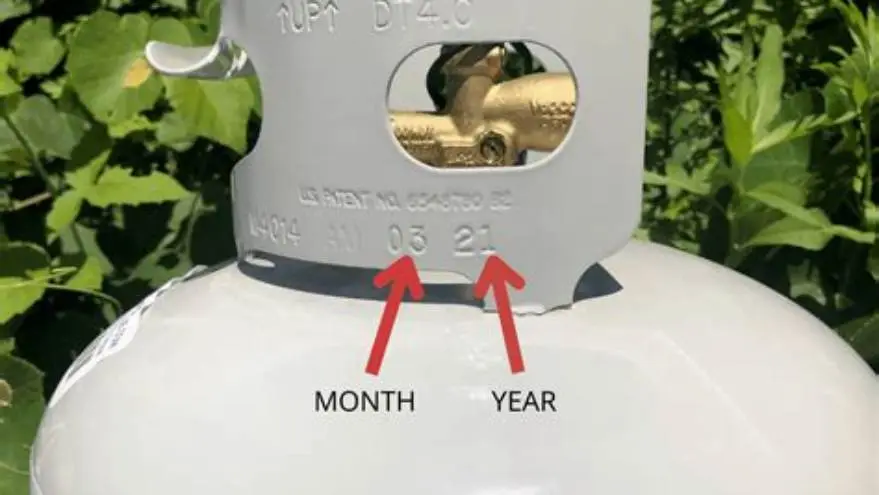
Every DOT cylinder keeps its stamps in one place, almost always the collar. On some, they sit on the foot ring or a shoulder plate. They're pressed into the metal, so paint won't erase them, but rust and thick coats can hide them. You're looking for two things: the original date and any later test stamp.
Low, sideways light makes shallow stamping readable. Your phone's flashlight works on most cylinders. If the collar is dark or pitted, a bright flashlight of 200 lumens or more, a measure of brightness, held almost flat against the metal does better.
- Close the valve and stand the cylinder on level ground outdoors, away from any flame or pilot light.
- Wipe the collar with a dry rag. Don't scrape it or use a wire wheel.
- Hold the light nearly flat to the metal and turn the cylinder slowly.
- Find the DOT line, such as
DOT 4BA240, and the maker's symbol and serial number near it. - Read the original date as month then year.
05 14means May 2014. - Look for a second set: letters and numbers, the requalifier's ID, a newer month and year, and sometimes an E.
- Photograph every stamp.
How do the requalification date and an added mark change the next due date?
For common steel propane cylinders of the DOT 4B, 4BA, and 4BW types, count 12 years from the original stamped date. That is the first requalification deadline. After a pass, the requalifier's stamp starts a new clock. People in this spot often ask about do propane tanks expire as well.
The added mark shows how the cylinder was checked, and the method sets the next interval. The figures below are typical for propane cylinders under 49 CFR Part 180. Confirm with your requalifier, because the stamp in your hand is what a filler will read.
Take a grill cylinder stamped 05 14. Its first requalification deadline is May 2026. Say you bring it in during April 2026 and it passes a volumetric test. The shop stamps its ID and 04 26. Add 5 years and the next test is due April 2031. A visual E stamp with the same date would run 7 years, to April 2033. Ask whether your filler counts to the end of the month.
Many people believe a cylinder is scrap when its first deadline arrives. It isn't. The deadline calls for a test, not automatic retirement, and plenty of cylinders pass and return to service. The catch is cost. For a 20 lb grill cylinder, the fee can come close to a new one, so call two requalifiers and compare with your local swap price. The other half of this decision is what heat does to the other 20%.
| Stamp you see | What it means | Usual next due |
|---|---|---|
| Date only, e.g. 05 14 | Original manufacture date | Use the first-requalification rule in this section |
| Requalifier ID plus new date | Volumetric expansion test: water-filled, pressurized, swelling measured | About 5 years after new date |
| New date plus E | External visual inspection | About 7 years after new date |
What does propane tank recertification mean for an ASME tank?
Nothing on an ASME tank expires the way a cylinder date does. The DOT requalification rules apply to cylinders, not to a 500 gallon home tank. The nameplate records the build year and normally stays in place. Don't hunt for a cylinder collar date that isn't there.
That doesn't mean nobody checks it. Your driver looks the tank over at delivery and should flag rust, dents, a leaning tank, and a damaged regulator or gauge. The pressure relief valve, the spring valve that vents gas if pressure climbs too high, has its own service limit.
NFPA 58, the National Fire Protection Association's LP-gas code, calls for ASME-container pressure relief devices to be replaced no later than 10 years after manufacture. The same limit applies to each replacement valve, measured from its manufacture date. This requirement appears in NFPA 58, 2024 edition, Section 6.7.2.1. NFPA 58 is a model code, not federal law, so check the edition adopted by your state or local authority. Before you commit to anything, it is worth looking at check propane tank level.
Rules shift when a tank has been out of service. Flooding, fire damage, a long empty stretch, or a move to a new spot usually brings an inspection and leak test before refilling. Requirements vary by state and supplier, so phone before you schedule. If the supplier owns the tank, that's their cost. If you own it, a licensed technician does the work, never you.
A motorhome's permanent tank follows the same path: nameplate, no cylinder collar date, and condition checked at the fill station. The portable bottle on a trailer tongue is a DOT cylinder, so it follows the dates described earlier. Ask your supplier when the relief valve was made and which NFPA 58 edition applies locally.
Why would a supplier refuse to fill my tank?
The usual reason is an out-of-date stamp. Federal hazmat rules in 49 CFR govern DOT cylinders, while NFPA 58 may add requirements where a state or local authority has adopted it. The person filling the container must follow the rules that apply at that location. Asking nicely won't change an unreadable or expired marking. People in this spot often ask about does a 1 lb propane tank last as well.
Other reasons come up too, and the filler can name each one:
- Expired date: past the applicable deadline with no newer stamp.
- No overfill valve: cylinders from 4 to 40 lb need an OPD, or overfill prevention device.
- Unreadable marks: if the filler can't read the date, they can't show it's valid.
- Damage: dents, deep gouges, rust pitting, fire marks, or a bulged shell.
- Valve trouble: a leaking valve, a bent collar, or an ASME relief valve past its service limit.
What should I ask a supplier or requalifier if the markings are unreadable?
Photograph the collar from two angles, then call a supplier that does cylinder work or a requalifier near you. A requalifier is a facility registered with the DOT, and its stamp carries a requalifier identification number, or RIN. Ask before you drive over, because not every supplier tests on site. Bring the photos and these questions:
- Registration: are you a registered requalifier, and what's your RIN?
- Identification: can you match the maker's symbol and serial number if the date is gone?
- Method: which test will you use, and which mark goes on the collar?
- Cost: what's the fee, and how does it compare with a swap or a new cylinder?
- ASME tank: when was my relief valve made, which code edition applies here, and do I need a leak test?
Key points
- Find the label first: collar or foot-ring stamps usually identify a DOT cylinder, while a nameplate helps identify an ASME tank.
- The newest stamp on a cylinder sets the clock, so read every line on the collar.
- Refusal to fill is the filler following the rules, not a mistake you can talk around.
- NFPA 58 is a model fire code, not federal law. Your state or local authority must adopt it before it applies there.
People also ask
Can I keep using a cylinder after its date passes?
The rule that bites is on filling, so gas already inside isn't the issue. Still, a cylinder nobody will refill is a dead end. Get it requalified or retire it through a supplier.
Does a swap-cabinet cylinder come with a valid date?
Exchange companies normally requalify or retire cylinders before they go back out, but I can't promise every cabinet does. Check the collar anyway. A badly rusted or dented cylinder isn't worth taking, whatever its date.
What is a volumetric expansion test?
The requalifier fills the cylinder with water, pressurizes it well above working pressure, and measures how much it swells and how much it springs back. Too much permanent swelling fails it. It's shop work, not a home job.
How do I find out my ASME tank's relief valve date?
Ask your supplier, who sees the valve at each fill. The valve body or a tag often carries a manufacture date. Compare it with the 10-year NFPA 58 service limit and the code edition adopted locally. Don't unscrew or tamper with it yourself.