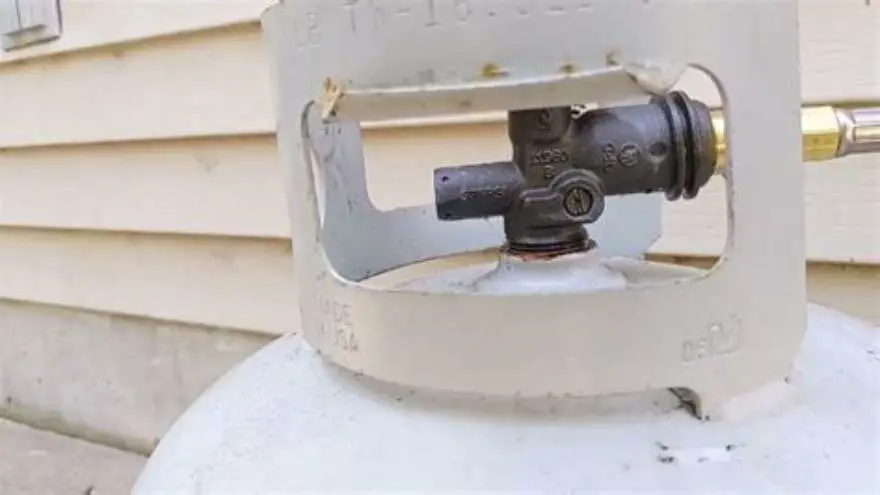
Propane tank freezing? Check tank pressure, not the frost
No, a propane tank won't freeze solid in winter air, since propane only solidifies near -306°F. What stops your appliance is cold: below about -44°F liquid can't boil into vapor, and a low or heavily drawn tank struggles well above that.

Propane Facts
- Freezes solid at
- about -306°F
- Stops boiling at
- about -44°F
- Pressure at 0°F
- about 24 psi
- Pressure at 70°F
- about 110 psi
- Full home tank reads
- 80% (400 gal in 500 gal)
- Appliance supply pressure
- about 11 in. water column
- Common winter refill point
- 20-30% (ask supplier)
Contents9 sections
- Can propane tanks freeze solid in winter air?
- Why does frost form on a propane tank shell?
- At what temperature does propane stop flowing?
- How do I tell a frosted shell from low pressure or an empty tank?
- How is a frozen regulator different from a frosted tank?
- What should I do next: refill, cut the load or warm the tank?
- What not to do
- Key points
- People also ask
Can propane tanks freeze solid in winter air?
When people ask can propane tanks freeze, they usually mean one of two things. Either the liquid turning solid, or the tank getting so cold the gas stops coming. The first never happens. The second does, and it's the one you're fighting.
Propane freezes solid at about -306°F (-188°C). No US winter gets within 200 degrees of that. Inside your tank, the propane is a liquid held under its own vapor pressure, and it stays liquid. You won't open a valve and find a block of ice.
What cold changes is how readily the liquid boils. Your appliance burns vapor, not liquid. The liquid turns to vapor at its surface, and it boils harder when warm. Well before the liquid reaches its boiling limit, tank pressure can fall low enough for regulators and burners to starve.
So the real question is how fast the liquid can boil compared with what you've got running. Walk out to the tank and note whether the frost sits on the shell, the regulator, or both. For the detail, see our notes on propane tank not releasing gas.
Why does frost form on a propane tank shell?
Frost means the liquid inside is boiling fast. Boiling takes heat, and the liquid pulls it from the steel around it. The shell can drop below 32°F on a 50°F day. Moisture in the air then condenses on the cold steel and freezes.
The frost usually ends in a neat line. That line sits near the liquid level, because only steel touching liquid gets chilled hard. Above it the shell stays warmer and clear. You get a rough level gauge for free.
Common belief: frost means the tank is freezing up and the ice is blocking the gas. What's actually true: the ice is a side effect of heavy vaporization, and it blocks nothing. Frost shows the tank is working hard. It doesn't show whether that's enough. It helps to understand spotting gas leaks before going further.
Heavy draw is the usual trigger. Think of a big heater, or a range and dryer running together. A low tank makes it worse, since less shell touches liquid. Wind strips heat from the shell, and shade keeps it cold. Dry cold can give no frost while the same thing happens inside.
At what temperature does propane stop flowing?
The practical answer depends on the tank, fuel level, weather and appliance load. Tank pressure must push vapor through the regulator, so flow can fade before the liquid reaches its boiling limit.
These figures describe the liquid's temperature, not the air's. Heavy draw can chill the liquid below the air. Fuel carrying some butane gives lower pressure in the cold. Treat every number as a ballpark.
A small cylinder feeding a heater can fade around 20-30°F under a heavy load. Treat that range only as a rule of thumb for a small cylinder and a high-BTU appliance, not as a universal cutoff. A half-full larger tank with a modest load can run well below 0°F.
Try it with a garage heater rated 120,000 BTU/h on its nameplate. Divide by 21,600 BTU per pound. That's about 5.6 lb of propane per hour, or 1.3 gallons at 91,500 BTU per gallon. A 20 lb cylinder lasts about 3.6 hours at best. It also has to boil 5.6 lb every hour. Compare the appliance input with the cylinder maker's vaporization rating for your temperature and fill level.
Use the cylinder manufacturer's vaporization chart for the comparison. A named reference is the Propane Education & Research Council's Propane Vaporization Chart, which lists rates by temperature, tank size and liquid level.
| Liquid temperature | Tank pressure | What you'll usually notice |
|---|---|---|
| 70°F | about 110 psi | No cold trouble |
| 32°F | about 50-55 psi | Frost under heavy draw |
| 0°F | about 24 psi | Small cylinders struggle under load |
| -20°F | about 10-12 psi | Weak flames, even on larger tanks |
| -44°F | about 0 psi | Liquid stops boiling, no vapor |
How do I tell a frosted shell from low pressure or an empty tank?
Test it, because frost alone can't tell you. For a portable cylinder, use an inline pressure gauge: a 0-200 psi dial that threads between the cylinder valve and the regulator. Fit it, brush soapy water on the joints, and open the valve slowly. Bubbles mean a leak, so close the valve and refit it. On a house tank, attach nothing. Read the tank gauge and ask your supplier for a pressure check.
Pressure doesn't show how much propane is left. It follows temperature, so a nearly empty cylinder in 70°F air still reads about 110 psi until the liquid runs out. Use weight or the tank gauge for level, and pressure for how the tank copes with cold. Do the four steps once on a cold morning before you buy or heat anything.
- Turn every appliance off and look at the shell. Note where the frost stops. That line roughly marks the liquid level.
- Check the level. A house tank gauge reads % of total volume, so a 500 gallon tank reading 20 holds about 100 gallons. For a cylinder, weigh it and subtract the tare weight (TW) stamped on the collar, often around 17 lb on a 20 lb cylinder.
- With the appliances still off, read the pressure and compare it with the table in the temperature section. A tank chilled by a long run reads low.
- Run the appliance for 5-10 minutes and watch the dial. A steady fall means vaporization can't keep up. A collapse toward zero on a light cylinder means empty. A steady reading with a weak flame points downstream.
| Level | Pressure, appliance off | Pressure under load | Most likely cause |
|---|---|---|---|
| Over 30% | Matches the table | Falls steadily, frost grows | Draw is higher than the tank can boil off |
| Over 30% | Matches the table | Holds steady, flame weak | Regulator, hose or appliance |
| Over 30% | Well below the table | Low and sagging | Liquid chilled by a long heavy run |
| Under 10% | Drops fast | Falls toward 0 | Nearly empty, refill |
How is a frozen regulator different from a frosted tank?
A frosted tank is cold steel with liquid boiling inside. A frozen regulator is ice on the small device where pressure steps down to what your appliance uses, about 11 inches water column. Tank frost points to heavy draw. Regulator ice points to a blockage or to something odd arriving from the tank.
Look at where the ice sits. Snow or ice over the regulator's small vent hole stops the diaphragm breathing, and flames sag or surge. Clear the vent by hand, keep it facing down, and prevent roof drips from reaching it.
Four causes cover most cases:
- Plugged vent: snow, ice or roof drip over the vent hole. Use the vent-clearing step above.
- Water in the line: moisture freezes at the small orifice inside. A technician has to purge it or replace the part.
- Liquid carryover: liquid reaching the regulator, from overfilling or a tilted cylinder, frosts it hard and can damage it. Shut the valve and call your supplier.
- Heavy flow: light frost on the regulator body under a big load is normal and harmless on its own.
What should I do next: refill, cut the load or warm the tank?
Work from the cheapest, easiest fix to the one that needs a technician. Most frosted tanks clear up at step 1 or 2.
- Cut the load. Turn off what you can live without for an hour. A rested tank warms and its pressure climbs back.
- Check the level and refill if it's low. Many suppliers like a refill around 20-30% in winter, so ask yours for its number. Swap a nearly empty cylinder.
- Give the tank sun and shelter. Put a board a few feet upwind, not touching, and keep snow off the shell. Wind and shade pull heat from the liquid.
- Add shell area. Two cylinders sharing the load, or one larger cylinder, give more steel to draw heat from. For a house tank, ask your supplier about a bigger or second tank.
- Ask about the regulator. Moving it away from roof drip, adding a cover or turning the vent down is licensed work on a house system. Don't do it yourself.
- Call your supplier if ice returns on a well-filled tank, if the regulator keeps icing, or if you smell gas.
What not to do
Skip the shortcuts. Don't put a flame, heat gun or space heater near the tank, and never bypass the regulator. A warmer made for LP cylinders is an option if you follow the maker's clearances.
Keep heater safety in view. A garage heater must be rated for indoor use, with ventilation and a carbon monoxide alarm in the space. Never bring an outdoor or tank-top heater inside, and keep cylinders outdoors. Start with step 1 tonight.
Key points
- Run the pressure test twice, appliance off and then on. A steady fall under load means heavy draw. A steady reading with weak flames points to the regulator or appliance.
- Cut the load first, then refill, then shelter the tank. Leave regulator moves and tank changes to your supplier.
- Use the no-flame warning in the safety section. Never heat a tank or regulator directly.
- Frost that stops in a neat line shows roughly where the liquid sits, so it works as a free level check.
People also ask
Does a low tank frost up faster than a full one?
Usually, yes. Less liquid means less shell in contact with it, so less heat flows in from the air to feed boiling. Trouble often shows once a tank is under about a quarter full and carrying a big load. Check your level before you blame the cold.
At what level should I refill in winter?
Ask your supplier, since policies differ. Many want a refill around 20-30%. On a 500 gallon tank, 25% on the gauge is about 125 gallons. A cylinder is better swapped before it feels light.
Is a propane tank warmer safe to use?
Only if it's made for LP cylinders and you follow its instructions and clearances. Never aim a heat gun, torch or space heater at a tank. Sun and a windbreak cost nothing and carry no risk.
Why does my house tank gauge read lower in the cold?
The gauge tracks liquid volume, and propane shrinks as it cools. The same amount of fuel can read a few points lower on a cold morning. Use it as a guide and ask your supplier if the number looks wrong.