Propane tank open but no gas: tripped flow limiter or bad regulator
A propane tank with gas but no flame usually has restricted flow from a tripped limiter, bad regulator or poor connection. Check the fuel level, then test the regulator and fittings without bypassing any safety device.
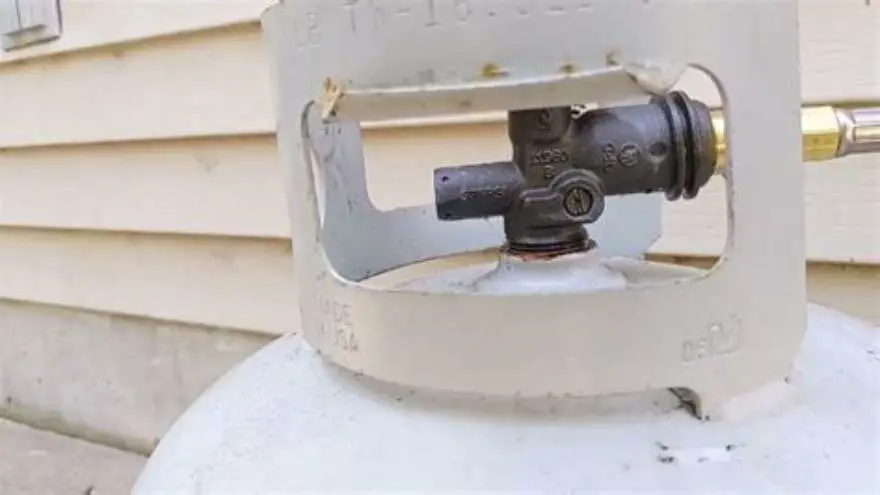
Part of the guide: Low grill flame: reset the tank valve before replacing the regulator
Propane Facts
- Full 20 lb tank
- about 37 lb with a 17 lb tare
- Propane in 20 lb tank
- about 4.7 gallons
- Wait before reopening
- about 1 minute, longer is fine
- Valve opening speed
- Open over several seconds; follow the label or manual
- Appliance pressure
- 11 in. w.c. (about 0.4 psi)
- Cylinder fill limit
- about 80% of volume
- Propane boiling point
- -44 F
Contents8 sections
- Is your propane tank not releasing gas, or just empty?
- Why does opening the valve too fast stop the gas, and how do you reset it?
- How can you tell a tripped limiter from a bad regulator?
- What makes a regulator lock up, freeze or clog?
- What if the tank is new, just refilled or overfilled?
- When should you replace the part, and who should do it?
- Key points
- People also ask
Is your propane tank not releasing gas, or just empty?
If your propane tank not releasing gas, check the fuel level before buying parts. A full cylinder can have a tripped safety valve, while an empty one needs a refill. Stop immediately if you smell gas. Three checks cost nothing and take only a few minutes.
Start with the handwheel. Turn it counterclockwise until it stops. Some tanks sit open only half a turn, which can restrict flow. Check the connection next. The plastic Type 1 nut on most grill tanks turns clockwise by hand until snug. A half-seated nut can keep the valve closed. A brass POL nut threads the other way.
Weigh the cylinder after checking the valve and connection. The empty weight, called the tare weight (TW), is stamped on the collar. If TW is 17 lb and the scale reads 22 lb, the tank contains 5 lb of propane. Divide 5 lb by 4.24 lb per gallon for about 1.2 gallons. That fuel stores roughly 108,000 BTU, using 21,600 BTU per pound.
A full 20 lb cylinder weighs about 37 lb, including the container. A reading near 17 lb means it is empty. A reading near 37 lb means fuel remains, so the restriction sits downstream. A 30,000 BTU/h burner would use about 1.4 lb per hour at full output, or roughly 3.6 hours from 5 lb. People in this spot often ask about propane tank freezing as well.
Read the gauge on a larger home tank instead. It shows the percentage of its usable volume, not gallons remaining. A full 500-gallon tank normally reads about 80 percent, or about 400 gallons. Portable appliances can also use quick-disconnect fittings. Check that fitting for a complete connection and damage before blaming the regulator.
Why does opening the valve too fast stop the gas, and how do you reset it?
Most modern cylinder valves and home-tank service valves contain a flow-limiting device. It's a small check that snaps shut when gas rushes out faster than normal. Its job is to stop a torn hose from emptying the tank. Crack the valve fast onto an empty, low-pressure hose and the surge looks exactly like a torn hose.
Some flow limiters allow a reduced bypass flow. The appliance may light weakly, but exact behavior depends on the valve design. The limiter resets when pressure on both sides evens out, so the hose side must be depressurized first.
People assume a tank that won't flow is empty or defective. It usually isn't. The tank is full, the limiter tripped, and a replacement cylinder would do the same if you opened it fast too. Here is the reset for a portable cylinder.
- Turn every appliance control and burner knob to off.
- Close the tank valve fully by turning it clockwise.
- Disconnect the regulator from the tank, outdoors and away from any flame or spark.
- Wait at least 1 minute. Some makers say longer, so check your regulator's label or manual.
- Reconnect the regulator, hand tight, with no wrench on a Type 1 nut.
- With the burners still off, open the tank valve slowly over several seconds until fully open. Follow the tank or regulator label and manual because required timing varies.
- Brush soapy water on the connection. Bubbles mean a leak, so close the valve. If it's clean, light the appliance as its manual says.
How can you tell a tripped limiter from a bad regulator?
Test one part at a time, starting with the tank connection and regulator. The table gives useful fault patterns without asking you to guess from one brief symptom. A second known-good tank can separate a tank-valve problem from an appliance problem.
Order the tests by cost. The reset in the previous section takes about a minute, depending on the maker's instructions. Borrowing a second cylinder costs nothing if a neighbor can help. A replacement regulator costs money, so test the existing parts before ordering one.
Never bypass the regulator. Propane vapor pressure varies with temperature, while the appliance expects about 11 inches of water column (in. w.c.), or around 0.4 psi. Connecting full tank pressure directly can damage the hose, burner valve or appliance. A regulator also needs the correct rating and connection type.
Disconnect the regulator only after closing the tank valve and confirming the appliance is cool. Some portable propane appliances use a quick-disconnect fitting between the hose and appliance. Release that fitting according to its instructions, and don't force a stuck collar.
- Move the same regulator and hose to a known-good tank. A normal flame points toward the original tank or valve. The same weak flame points toward the regulator, hose or appliance.
- Fit a known-good regulator with the correct rating to the original tank. Normal operation identifies the old regulator as the failed part.
- If both regulators behave the same, shut everything down. Inspect the burner tubes and venturi for webs, dirt or blockage before trying again.
- If a reset and known-good regulator still don't restore flow, check the tank valve. It should turn smoothly without binding. A stuck handwheel, damaged valve or failed OPD can stop gas flow. Don't force or repair the valve. Return the tank to the supplier for inspection or exchange.
| Cause | What the flame does | What the test shows |
|---|---|---|
| Tripped limiter | Weak or restricted flow | The reset restores normal flow |
| Locked-up regulator | No flame, or a flame that dies within seconds | A known-good regulator works on the same tank |
| Frozen regulator | The appliance fades after running; frost appears on the regulator | Flow returns after the regulator warms in open air |
| Webs in burner or venturi | Yellow, uneven flame, or popping near the controls | The same fault appears with a second tank; cleaning clears it |
What makes a regulator lock up, freeze or clog?
Regulators are simple. A spring and a diaphragm lower tank pressure to what your appliance can take. They fail in a handful of predictable ways, and each leaves a clue you can check by eye.
Cold alone rarely stops the flow. Propane boils at -44 F, so a tank still makes vapor in a hard freeze. A nearly empty tank in freezing weather simply delivers less, because there's little liquid to boil. That's slow supply, not a fault. Let a frozen regulator warm on its own in open air, and never use a flame or heat gun.
Look at the vent hole and the burner tubes with a flashlight before you spend anything. Both take two minutes.
- Lockup after over-pressure: a pressure spike, such as liquid propane from an overfilled or tipped tank, can leave the diaphragm stuck shut. Replace it, don't hope.
- Frozen regulator: moisture freezes on it in cold, damp weather, or heavy draw chills it. Look for frost on the body and flame that fades after minutes.
- Blocked vent: the small hole in the regulator bonnet lets the diaphragm breathe. Insects, mud, paint or ice plug it. The vent should point down.
- Spider webs: they clog burner venturi tubes, often after a season in storage. Expect a yellow, uneven or low flame. Clean cold burners with a venturi brush and the tank valve closed.
What if the tank is new, just refilled or overfilled?
New cylinders ship with air inside. The filler is supposed to purge it, meaning bleed the air out before adding propane. If that step is skipped, air sits in the vapor space. You get a weak or sputtering flame, or an appliance that won't hold a light. The tank itself is fine.
Take it back to the place that filled it and ask them to purge and check it. Don't bleed it yourself. Venting propane near a grill, a car or a garage door is a fire risk. A tripped limiter clears with the slow-open reset, and an air problem doesn't. That's how you tell them apart.
Overfilling causes the opposite trouble. Cylinders are meant to stop at about 80% of volume, which leaves room for liquid to expand. Fill past that and liquid can reach the regulator. You'd see a roaring yellow flame, then a regulator that frosts, sticks or locks up.
Move an overfilled tank outdoors, upright and in shade, and call the filler. On a home tank, a technician handles any purge or overfill. If the trouble started right after a fill, call the filler before you replace anything.
When should you replace the part, and who should do it?
Replace the regulator when a swap test proves it, when it's cracked or corroded, when it has iced up more than once, or when liquid propane reached it. Replace a hose that's cracked, brittle or kinked. The stamped date or the maker's manual gives the service life. I'd rather replace it at that age than at a failed cookout.
Match the new part to the old one. For a grill or portable heater, look for an outlet of 11 in. w.c., the same tank connection (Type 1 or POL), and a capacity above the appliance's total BTU/h on its data plate. A regulator rated lower starves the burner. RVs and homes need a type matched to the system, so follow that manual.
Who does the work depends on where the part sits. You can swap a hand-tight regulator and hose on a grill or portable heater. Anything on fixed piping, an RV two-stage regulator, or any home-tank regulator is a job for a licensed LP-gas technician working to NFPA 58 and NFPA 54. Confirm all state and local propane-handling rules with your local code authority or supplier, especially for fixed piping. Nobody but the supplier should touch a tank valve. If a limiter keeps tripping despite slow opening, the tank goes back. Photograph the regulator's label now so you can match it, and call a technician for anything beyond a hand-tight swap.
Key points
- A gas smell ends the troubleshooting. Leave, and call from outside.
- Weigh the cylinder before you touch anything else. Near 37 lb means gas is in there.
- A blocked vent hole and spider webs cost nothing to check, so look before you buy.
- If a reset and known-good regulator don't restore flow, return the tank. Its valve or OPD may be stuck.
People also ask
How long should I wait before reopening the valve?
Usually about a minute with the regulator disconnected. Makers differ, so check the label or manual. A longer wait costs nothing, and five minutes is fine.
Can the limiter trip on a home tank, and what do I do?
Yes, a surge or a leak downstream can trip it. Don't disconnect anything. Close the appliance valves and call your supplier. If you smell gas, leave and call from outside.
Why does my flame start strong, then fade after a few minutes?
That points to a freezing regulator or a nearly empty tank in cold weather. Look for frost on the regulator and weigh the tank.
Is it safe to warm a frozen regulator with warm water?
It's contested. Some people pour warm, never hot, water over it. Others say wetting the vent invites refreezing. I'd let it warm in open air outdoors, and never use a flame or heat gun.
