Propane vs natural gas cost: the $/gallon to $/therm conversion
Propane vs natural gas cost is easiest to compare in dollars per therm. Divide propane’s price per gallon by 0.915, then include tank fees, taxes, and delivery charges. Compare that figure with your bill’s natural-gas therm rate plus fixed charges. Local rates decide the winner.
Part of our guide on fuel cost break-even point
Propane Facts
- Propane energy
- about 91,500 BTU per gallon
- One therm
- 100,000 BTU
- One gallon in therms
- 0.915 therm
- One ccf in therms
- utility-specific, often about 1.04 therms
- Propane to $/therm
- price per gallon ÷ 0.915
- Gas ccf to $/therm
- price per ccf ÷ the bill's therm factor
Contents8 sections
- How do you turn a propane price per gallon into a price per therm?
- How do you read a natural gas bill to find the real price per therm?
- What does a propane bill add on top of the price per gallon?
- How does propane vs natural gas cost change for a range versus whole-house heat?
- Does furnace efficiency change which fuel costs less?
- How long does a natural gas hookup take to pay back?
- Key points
- People also ask
How do you turn a propane price per gallon into a price per therm?
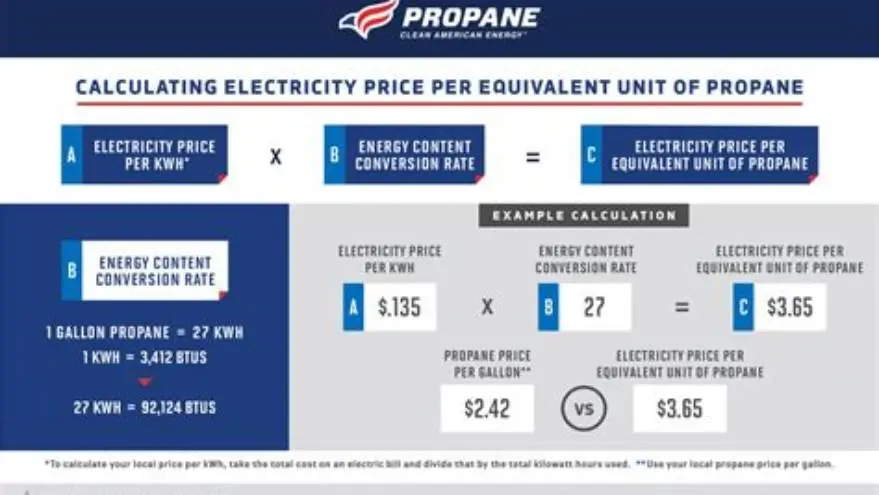
Propane holds about 91,500 BTU per gallon, and one therm equals 100,000 BTU. One gallon therefore contains about 0.915 therm. Divide the propane price per gallon by 0.915 to get fuel cost per therm.
For example, $2.80 per gallon ÷ 0.915 equals $3.06 per therm. This is fuel energy cost, not the cost of heat delivered into your rooms.
Natural gas uses the same method. If the utility charges $1.35 per ccf and the bill's therm factor is 1.04, use this formula: natural-gas $/therm = $/ccf ÷ therms per ccf. The result is $1.30 per therm.
| Unit | Heat content | Divide the price by |
|---|---|---|
| Propane, 1 gallon | about 91,500 BTU, or 0.915 therm | 0.915 |
| Natural gas, 1 therm | 100,000 BTU | 1 |
| Natural gas, 1 ccf, or 100 cu ft | utility-specific, often about 1.04 therms | the bill's therm factor |
| Natural gas, 1 mcf, or 1,000 cu ft | about 10.4 therms | the bill's stated factor, often about 10.4 |
How do you read a natural gas bill to find the real price per therm?
Find the bill's therm factor, commodity rate, delivery rate, customer charge, taxes, and riders. Utilities can vary gas heat content, so use the stated factor instead of assuming every ccf equals 1.04 therms. People in this spot often ask about annual household propane use as well.
If your bill already prices gas in therms, use this formula: annual gas cost = annual therms × variable $/therm + annual fixed charges + annual taxes and surcharges. If the fixed charge appears monthly, multiply it by 12 once.
If the bill uses ccf, add variable per-ccf charges, then divide by the stated therm factor. Add taxes and surcharges according to how the utility applies them. Keep fixed charges separate because you pay them even with little usage.
- Commodity rate: the cost of gas itself, per therm or ccf.
- Delivery charge: the variable cost for transporting gas through the utility system.
- Fixed monthly fee: a customer or basic-service charge that can continue when usage is near zero.
- Taxes and riders: percentage or fixed add-ons listed on the bill. Include them in the same annual comparison.

Flame King Propane Tank Digital Scale for 5LB
Weigh your cylinder against its stamped tare weight on a scale built for 5-40 lb propane tanks, so you can see how much gas was delivered.
What does a propane bill add on top of the price per gallon?
A propane comparison should state whether the quoted price includes delivery, taxes, surcharges, and tank charges. Use the same treatment for both fuels. A price that excludes those items is not an all-in price. The other half of this decision is using your electric rate to decide.
For a worked fee example, assume propane costs $2.80 per gallon and a $50 delivery fee. On a 100-gallon fill, the fee adds $0.50 per gallon. On a 40-gallon fill, it adds $1.25 per gallon. The smaller order has the higher delivered price because the same fee covers fewer gallons.
Tank rental, minimum purchase charges, fuel surcharges, hazmat charges, and administrative fees depend on the supplier. Read the delivery ticket and contract rather than treating any one charge as universal.
A 20-pound cylinder holds about 4.7 gallons when filled by weight. Exchange programs can contain less propane. Check the label or weigh the cylinder against its stamped tare weight. It helps to understand propane vs electric heat cost before going further.
- Tank rental: a yearly charge if the supplier owns the tank.
- Delivery fee: a flat charge per stop or order.
- Minimum-fill fee: a charge tied to ordering below the supplier's minimum volume.
- Surcharges and taxes: contract- and supplier-specific additions.
How does propane vs natural gas cost change for a range versus whole-house heat?
Use your measured annual consumption when possible. Add the therms on your gas bills, or multiply propane gallons by 0.915. The following figures are hypothetical worked examples, not typical-home statistics.
For a worked example, assume 800 therms of annual space-heating use. Assume a 95,000-BTU furnace runs about 842 equivalent full-output hours during the year. This is a calculation assumption, not a claim about average usage. Assume propane costs $2.80 per gallon, gas costs $1.30 per therm, and each quoted variable price excludes taxes and surcharges.
For a separate low-use scenario, assume a 36,000-BTU range and a 40,000-BTU water heater together consume 144 therms annually. That number comes from the scenario's assumed burner ratings and operating hours, not a survey. Measure your setup from bills or fuel deliveries instead.
Gas costs also depend on its fixed charge. A $15 monthly customer charge adds $180 per year. Propane may have rental or delivery charges. A low-use appliance can leave a gas hookup with ongoing fixed charges even when it uses little gas.
| Scenario | Annual energy | Gas variable cost | Propane variable cost |
|---|---|---|---|
| Range plus water heater | 144 therms, assumed | 144 × $1.30 = $187 | 144 ÷ 0.915 × $2.80 = $440 |
| Space heating | 800 therms, assumed | 800 × $1.30 = $1,040 | 800 ÷ 0.915 × $2.80 = $2,448 |
Does furnace efficiency change which fuel costs less?
Fuel price per therm is only the starting point. Appliance efficiency determines how much heat reaches your home. For a furnace, use cost per useful therm = fuel cost per therm ÷ AFUE. A boiler uses its rated seasonal efficiency. A water heater uses its UEF or another listed performance rating.
Using the example prices, an 80% natural gas furnace costs $1.30 ÷ 0.80, or $1.63 per useful therm. A 96% propane furnace costs $3.06 ÷ 0.96, or $3.19. Higher efficiency narrows the gap, but it doesn't erase a large fuel-price difference.
Ranges usually lack an AFUE rating. Compare them using measured fuel consumption, burner input, and cooking hours. Burner input shows how much fuel the appliance uses. Your actual cooking pattern determines the final cost.
A conversion kit isn't always required or approved. Some appliances accept a manufacturer-specific kit, while others need replacement. Check the appliance instructions and fuel approval before buying parts. Use a qualified gas-appliance technician, and follow the manufacturer's instructions and local code. Licensing and permit rules vary by location.
How long does a natural gas hookup take to pay back?
Divide the complete hookup cost by your expected annual savings. Include every charge before comparing fuels. Count propane deliveries, tank fees, taxes, surcharges, natural-gas customer charges, delivery fees, and maintenance differences.
A range usually creates modest savings because it burns little fuel. Its monthly gas charge can absorb much of the difference. Whole-house heating uses more energy, so it often offsets installation costs sooner. Your own bills determine the result.
Request a written quote before deciding. The quote should include the service line, meter, trenching, indoor piping, appliance work, permits, restoration, and utility charges. Use a qualified gas-appliance technician. Follow the manufacturer’s instructions and local code. Licensing and permit rules vary.
Use your delivery records instead of a household average. Convert propane gallons to estimated therms with 0.915. Use the natural-gas bill’s therm factor and variable rate. If it already lists therms, skip the ccf conversion. Test the payback with higher and lower fuel prices. Rate changes can stretch a short payback.
- Add propane gallons from delivery records. Multiply the total by
0.915for estimated therms. - Record the natural-gas bill’s variable rate and therm factor. Skip conversion when the bill lists therms.
- Calculate annual natural-gas cost, including variable charges, customer charges, taxes, and surcharges.
- Calculate annual propane cost, including delivered fuel, tank charges, minimums, taxes, and surcharges.
- Compare the annual totals. Divide the hookup quote by the yearly cost difference.
- Repeat the calculation with higher and lower fuel prices. Check whether the payback still suits your plans.
Natural gas can cost less per delivered therm, but a hookup only makes sense when fuel savings outweigh installation and ongoing fixed charges.
Key points
- Use the bill's therm factor when your natural-gas utility provides one. A ccf measures volume, while a therm measures heat.
- Separate fuel cost from delivered heating cost. Furnace, boiler, water-heater, and range efficiency changes the heat you receive.
- Include delivery fees, taxes, surcharges, tank charges, and gas customer fees in the annual comparison.
- A low-use appliance can leave a gas hookup with too little yearly fuel savings to justify its installation quote.
- Tank ownership, minimum purchases, and supplier choice depend on the contract and local rules.
People also ask
How do I convert heating oil or electricity to a price per therm?
Heating oil contains about 1.385 therms per gallon, so divide its price per gallon by 1.385. Electricity uses about 29.3 kWh per therm of input energy. Multiply your electricity rate by 29.3, then divide by the appliance's efficiency or heat-pump performance.
Should I buy my leased propane tank?
Check the contract before deciding. Owning may remove the rental charge and may make supplier shopping easier, but check the tank contract and local rules before buying. The agreement may include minimum purchases, inspection duties, delivery restrictions, or supplier limits. Compare the buyout price with future rental and service costs.
How many gallons does a delivery to a 500-gallon tank actually take?
A tank normally fills to about 80% of its water capacity, so a 500-gallon tank holds about 400 gallons of propane at the fill limit. The exact delivery depends on the starting gauge, tank condition, and supplier policy. Check the ticket rather than estimating from the gauge alone.
Can I switch my propane appliances to natural gas myself?
Don't do the conversion yourself. Some appliances accept a manufacturer-approved conversion kit, while others require replacement. Check the manual and approval label. Use a qualified gas-appliance technician and follow the manufacturer’s instructions and local code; licensing and permit requirements vary. If you smell gas, leave the area and call your supplier or emergency services from outside.