Propane vs electric heat: the break-even COP by fuel price
A heat pump beats propane when its COP is above about 1.36 at $3.00 per gallon propane, $0.16 per kWh power and a 95% furnace. Baseboard electric heat has a COP of 1.0, so it needs a lower electricity rate to compete.
Part of our guide on fuel cost break-even point
Propane Facts
- Propane energy
- 91,500 BTU per gallon
- Electricity energy
- 3,412 BTU per kWh
- Break-even COP
- 26.8 × rate × AFUE ÷ price
- Table range
- COP 0.76 to 2.04
- Resistance heat COP
- 1.0 at any temperature
- 1,500 W heater output
- about 5,100 BTU/h
- HSPF to COP
- divide HSPF by 3.412
Contents11 sections
- How do propane and electric heat costs compare per million BTU?
- What's the difference between electric resistance heat and a heat pump?
- How do HSPF and HSPF2 differ, and what do they mean for your COP?
- How much does furnace efficiency add to propane heat cost?
- What heat pump COP do you need to beat propane?
- How do you plug in your own propane, electricity and equipment rates?
- What costs sit outside the fuel comparison?
- How does resistance backup heat change the break-even calculation?
- Why is a heat pump cheaper in mild weather but weaker in deep cold?
- Key points
- People also ask
How do propane and electric heat costs compare per million BTU?
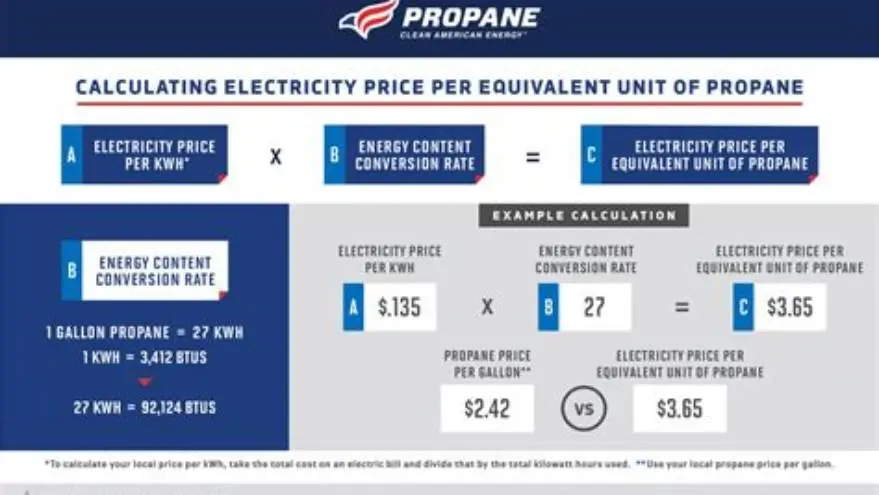
Propane and electric heat use different units, so a gallon price cannot be compared directly with a kilowatt-hour price. Convert both fuels to dollars per million BTU, or MMBTU. A gallon of propane contains about 91,500 BTU, while one kWh contains 3,412 BTU.
Divide the propane price by 0.0915 to find its fuel cost per MMBTU. At $3.00 per gallon, the result is $32.79. Multiply the electric rate by 293 to find resistance-heat cost per MMBTU. At $0.16 per kWh, the result is $46.89.
Every dollar figure in this article is an illustrative example, not a current market price. Residential propane prices vary by state, delivery size and season. Electricity rates vary with utility, taxes, delivery charges and time of use.
The U.S. Energy Information Administration publishes regional propane context in its Heating Oil and Propane Update. The publication reports weekly residential propane prices for the states included in its survey during the heating season, generally October through March. Check the current [Heating Oil and Propane Update](https://www.eia.gov/petroleum/heatingoilpropane/) for the covered states and months before treating $3.00 as low or high. There is more on propane vs natural gas cost in a separate guide.
What's the difference between electric resistance heat and a heat pump?
Electric resistance heat sends power through a wire or coil. Baseboards, electric furnaces and plug-in heaters work this way. Each kWh becomes about 3,412 BTU, so its COP, or heat out divided by energy in, is 1.0.
Heat pumps move heat instead of making it. In mild weather, many air-source models deliver more heat than the electricity they consume. COP falls as outdoor temperature drops, and defrost cycles consume some energy.
A standard heat pump is designed around ordinary heating conditions and can need resistance backup sooner. A cold-climate heat pump is tested and designed to keep operating at lower temperatures, but its capacity and COP still depend on the model. Don't assume a cold-climate label gives one fixed COP. Before you commit to anything, it is worth looking at how much propane does a house use.
Portable electric heaters are resistance heat. A 1,500 W unit produces about 5,100 BTU/h while operating. Check its electrical label and measure actual runtime with a plug-in kWh meter if you need a household estimate.
| Heating method | Delivered heat per kWh or gallon | Cost per MMBTU | Cold-weather behavior |
|---|---|---|---|
| Electric resistance | 3,412 BTU per kWh delivered (COP 1.0) | $46.89 | Same conversion at any temperature |
| Heat pump, COP 3.0 | about 10,200 BTU per kWh delivered | $15.63 | Output and COP fall as it gets colder |
| Heat pump, COP 2.0 | about 6,800 BTU per kWh delivered | $23.45 | May need backup heat sooner |
| Propane furnace, 95% AFUE | about 86,900 BTU per gallon delivered after AFUE | $34.51 | Combustion output is less sensitive to outdoor temperature |
How do HSPF and HSPF2 differ, and what do they mean for your COP?
HSPF, or Heating Seasonal Performance Factor, is an older seasonal efficiency rating for heat pumps. HSPF2 uses a revised test procedure introduced by DOE for equipment rated from 2023 onward. The two numbers are not interchangeable: HSPF2 values run lower for the same equipment because the test is more demanding.
Divide HSPF by 3.412 to get a rough seasonal average COP. Divide HSPF2 by 3.412 the same way. Check the equipment label to see which rating applies. New equipment sold after the 2023 federal standard change will carry HSPF2.
Either figure is a seasonal average for a standard test climate, not your January COP. Use the manufacturer's performance data at the outdoor temperatures relevant to your site.
How much does furnace efficiency add to propane heat cost?
Furnace efficiency is the share of propane energy delivered as useful heat. The rating is AFUE (Annual Fuel Use Efficiency). Use the AFUE printed on the furnace label. Do not infer it from the furnace's age or design.
Older equipment may have lower efficiency than a current condensing model. If the label is missing, check the installation paperwork or manual. If the rating is still unavailable, record actual gallons used and the delivered heat over a known period to estimate efficiency rather than guessing.
The delivered propane cost is price per gallon ÷ (0.0915 × AFUE). At $3.00 per gallon, a 95% furnace costs $34.51 per delivered MMBTU. An 80% furnace costs $40.98. For the same delivered heat, an 80% furnace at $3.00 costs the same as a 95% furnace at $3.56.
Find the AFUE on the equipment label, installation paperwork or manual. Don't infer efficiency from vent-pipe color alone.

SURAIELEC Outlet Watt Meter
Lets you meter a plug-in electric heater up to 16 A and 3,680 W and logs energy to 0.001 kWh, so you can compare real electric heat consumption against propane.
What heat pump COP do you need to beat propane?
Break-even COP is the heat-pump efficiency where both systems cost the same per delivered MMBTU. Above that number, the heat pump has the lower running cost. For a propane furnace, use COP = 26.8 × electricity rate × AFUE ÷ propane price.
At $0.16 per kWh, $3.00 propane and 95% AFUE, the calculation is 26.8 × 0.16 × 0.95 ÷ 3.00, or 1.36. The table shows the same comparison across example prices.
Read the table as a running-cost comparison only. It does not show whether the heat pump can carry the home's load at that temperature. Use the manufacturer's low-temperature capacity and COP data for that question.
The break-even formula applies while the heat pump supplies all delivered heat. When outdoor temperature drops low enough that resistance backup strips run, those strips deliver heat at COP 1.0. See the dual-fuel and backup section below for how to adjust the calculation.
| Propane price per gallon | $0.12 per kWh | $0.16 per kWh | $0.20 per kWh |
|---|---|---|---|
| $2.50 | 1.22 | 1.63 | 2.04 |
| $3.00 | 1.02 | 1.36 | 1.70 |
| $3.50 | 0.87 | 1.16 | 1.46 |
| $4.00 | 0.76 | 1.02 | 1.27 |
How do you plug in your own propane, electricity and equipment rates?
Use measured household rates and the equipment data for your climate. One set of formulas cannot predict capacity, defrost energy or backup use.
- Propane price: divide the total delivery charge by gallons delivered. Include delivery fees and other charges tied to that delivery. The examples in this article use a per-gallon figure that covers those costs. Treat a separate tank rental as an annual fixed cost and add it outside the fuel formula.
- Electric rate: divide the bill's total variable charges by kWh used. Include delivery charges and taxes when they rise with added usage. If your utility uses tiered or time-of-use pricing, use the marginal rate only when your heating load falls in that tier or time band. Using the marginal rate on a flat-rate tariff will overstate your cost.
- Furnace AFUE: use the rating from the equipment label, paperwork or manual. If it is unavailable, record actual fuel use and delivered heat over a known period to estimate efficiency. Older equipment may have lower efficiency than a current model.
- Heat pump COP: use the manufacturer's low-temperature performance table at the rated point nearest your usual outdoor temperature. See the HSPF and HSPF2 section above for how to read the seasonal rating on the label.
- Propane cost: divide propane price by 0.0915 × AFUE to get dollars per delivered MMBTU.
- Electric heat-pump cost: multiply the electric rate by 293, then divide by COP. Compare the result with propane cost.
What costs sit outside the fuel comparison?
Tank rental, utility connection charges, repairs and equipment purchases are fixed or capital costs. Add them separately instead of hiding them in the fuel conversion. The EIA Heating Oil and Propane Update can provide regional price context, but your delivery terms still control your actual cost.
A plug-in kWh meter can measure a space heater's energy use. A 1,500 W heater running for 10 hours uses up to 15 kWh. At $0.16 per kWh, that is $2.40 before thermostat cycling reduces runtime.
How does resistance backup heat change the break-even calculation?
Many heat pumps include electric resistance strip heat as backup. Those strips run at COP 1.0. When they operate alongside or instead of the heat pump, your average COP for that period falls below the heat pump's rated figure.
To account for backup, split your heating hours into two groups: hours the heat pump runs alone and hours the strips run. For heat-pump-only hours, use the break-even formula as written. For strip-only hours, treat COP as 1.0 and compare directly with propane cost per MMBTU.
A simple weighted formula: total electric cost = (heat-pump hours × rate × 293 ÷ COP) + (strip hours × rate × 293). Compare that total with propane cost over the same period. This keeps the two operating modes separate and avoids overstating heat-pump savings.
A dual-fuel system replaces electric strip heat with the propane furnace when the controller changes over. The break-even formula in the table above applies only while the heat pump supplies all delivered heat. Once the furnace takes over, use the propane delivered-cost formula for those hours.
Why is a heat pump cheaper in mild weather but weaker in deep cold?
A heat pump can keep running below freezing, but cold weather reduces both COP and heating capacity. Frost can trigger defrost cycles, and the house loses heat faster as outdoor temperature falls.
The balance point has two meanings. An economic balance point is the temperature where the heat pump and propane furnace cost the same for delivered heat. A capacity balance point is where the heat pump can no longer meet the home's heating load. A controller can use either setting.
A dual-fuel system pairs the heat pump with a propane furnace instead of strip heat. With an economic setting, the controller switches equipment when propane becomes cheaper per delivered MMBTU. With a capacity setting, it switches when the heat pump cannot meet the load.
Use the manufacturer's capacity and COP data at the low-temperature points closest to your climate. A standard heat pump may need furnace backup sooner than a cold-climate model. The furnace can still be cheaper in deep cold, even when the heat pump continues operating.
For a seasonal cost estimate, record the hours each system actually runs, the heat pump's low-temperature COP, the furnace AFUE and the strip backup rate. That gives you a real seasonal cost instead of assuming one COP applies all winter.
At the example prices, a heat pump can cost less per delivered BTU in moderate weather. A propane furnace may still provide lower-cost or necessary backup during long, cold periods.
Key points
- Convert both fuels to dollars per MMBTU: propane price ÷ 0.0915, electric rate × 293.
- Write AFUE (Annual Fuel Use Efficiency) as a decimal in the propane formula.
- A published seasonal rating is not a January COP. Use the manufacturer's performance data at the outdoor temperatures relevant to your site.
- A standard heat pump and a cold-climate heat pump can have different low-temperature output and efficiency.
People also ask
Do tank rental fees change the result?
Yes, but they are fixed annual costs rather than fuel costs. Add the yearly rental charge to the propane system's annual total, then compare both systems over the same period.
Does a propane boiler or vent-free heater use the same formula?
A boiler uses its own AFUE in the same delivered-cost formula. Vent-free heaters have different safety and ventilation concerns. Follow local code, use a carbon-monoxide alarm and don't treat a rating as permission for indoor use without proper installation.
Does the COP on the heat pump box match what I'll get in January?
No. A published seasonal rating is not a January COP. Use the manufacturer's performance table at the rated low-temperature points nearest your outdoor conditions. Check the equipment label to confirm whether the rating shown is HSPF or the newer HSPF2, since the two use different test procedures and are not interchangeable.
How do I estimate heat-pump payback?
Subtract the heat pump's annual operating cost from the propane system's annual operating cost. Divide the net installed cost, after rebates, by that annual saving. Worked example: a $9,000 installed cost minus a $2,000 rebate leaves $7,000. If the heat pump saves $700 per year, simple payback is 10 years. Use your own annual costs and exclude savings that depend on unverified runtime.