Propane vs heating oil: the price per gallon where they break even
It depends on your fuel quotes and equipment. Propane needs to cost about three-quarters of oil, assuming an 80% oil unit and a 95% condensing propane unit. The range is about 0.66 to 0.84 when those equipment efficiencies change. Heating oil contains about 138,500 BTU per gallon, while propane contains about 91,500 BTU.
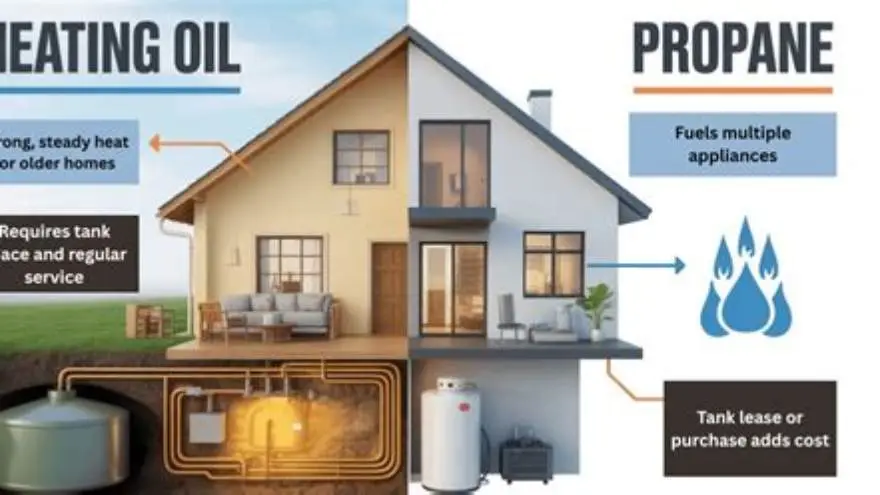
Propane Facts
- Heating oil heat
- About 138,500 BTU per gallon
- Propane heat
- About 91,500 BTU per gallon
- Propane per oil gallon
- About 1.5 gallons before equipment efficiency
- Default oil AFUE for the example
- 80%
- Default condensing propane AFUE for the example
- 95%
- Break-even ratio
- About 0.66-0.84, depending on equipment
- Propane tank fill limit
- Usually about 80% of tank volume
Contents8 sections
- Is propane cheaper than heating oil, and by how much?
- How does equipment efficiency change the break-even price?
- How do you work out break-even from your own two quotes?
- What do per-gallon prices leave out?
- Why does the answer change by region and season?
- Will fuel savings pay for switching from oil to propane?
- Key points
- People also ask
Is propane cheaper than heating oil, and by how much?
A lower per-gallon propane quote doesn't guarantee lower heating costs. Heating oil contains about 138,500 BTU per gallon. Propane contains about 91,500 BTU per gallon. Fuel grade and measurement conditions can cause small differences.
Compare the heat reaching your rooms. Multiply each fuel's energy per gallon by the furnace or boiler's AFUE rating. Oil carries more energy per gallon, but equipment efficiency determines how much becomes useful heat.
The U.S. Energy Information Administration publishes residential heating oil and propane prices by region and week. For a dated comparison, use the EIA week ending November 24, 2023, then select your state or region. These averages won't match every delivery quote.
This example uses $4.00 per gallon for oil and $3.20 for propane. Propane still costs more per million BTU before efficiency because each gallon contains less energy. Replace these figures with your own prices. If that sounds like your situation, read up on how furnace efficiency affects the comparison next.
| Fuel | Heat per gallon (BTU) | Gallons per million BTU | Example price per gallon | Fuel cost per million BTU |
|---|---|---|---|---|
| Heating oil | 138,500 | 7.22 | $4.00 | $28.88 |
| Propane | 91,500 | 10.93 | $3.20 | $34.98 |
How does equipment efficiency change the break-even price?
AFUE stands for Annual Fuel Use Efficiency. It tells you how much fuel energy becomes useful heat over a heating season. An 80% unit provides about 80 BTUs of useful heat for every 100 BTUs burned.
The U.S. Department of Energy uses AFUE to describe furnace and boiler efficiency. Older equipment varies widely, so don't treat a broad range as your unit's rating. Use the nameplate or manual, or ask a technician for a combustion test.
Here is a worked example. It uses 100 million BTU of annual oil input, which equals about 722 gallons at 138,500 BTU per gallon. The oil equipment has an 80% AFUE, and the condensing propane equipment has a 95% AFUE. Oil costs $4.00 per gallon. We go through comparing delivered energy costs step by step elsewhere on the site.
The oil fuel cost is 722 gallons × $4.00, or $2,888. The oil system delivers 100 million × 0.80, or 80 million useful BTUs. Propane needs 80 million ÷ 0.95, or 84.21 million BTU of fuel. At 91,500 BTU per gallon, that requires about 920.3 gallons. At $2.50 per gallon, propane costs 920.3 × $2.50, or about $2,301. The saving is $2,888 − $2,301, or about $587 per year.
The break-even ratio in this example is (91,500 × 0.95) ÷ (138,500 × 0.80), which equals about 0.78. At $4.00 oil, propane breaks even near $3.14 per gallon. Equipment ratings and actual operating conditions can change the result.
How do you work out break-even from your own two quotes?
Use this formula: (propane BTU per gallon × propane AFUE) ÷ (oil BTU per gallon × oil AFUE). Multiply the result by your delivered oil price. That gives the highest propane price that matches oil on fuel cost. The other half of this decision is estimating a home's fuel needs.
- Write down the delivered oil price and date from a current quote or invoice.
- Write down the propane price for the same date, including fees converted to a per-gallon amount.
- Use the AFUE shown on each equipment nameplate or in its manual. Ask a technician for a combustion test when the rating is missing.
- Multiply 138,500 by the oil AFUE and 91,500 by the propane AFUE.
- Divide the propane result by the oil result.
- Multiply that ratio by the oil price. A propane quote below the result costs less for the same useful heat.
| Oil unit AFUE | Propane unit AFUE | Ratio | Break-even propane price |
|---|---|---|---|
| 75% | 95% | 0.84 | $3.35 |
| 80% | 95% | 0.78 | $3.14 |
| 85% | 95% | 0.74 | $2.95 |
| 80% | 80% | 0.66 | $2.64 |
What do per-gallon prices leave out?
The invoice can include costs that a headline price hides. Add each yearly charge to the fuel total, then divide by the gallons you expect to use. Apply the same treatment to oil and propane.
Check delivery fees, minimum fills, tank rental, price-lock terms, service contracts, and prepayment requirements. Propane quotes also differ between will-call delivery and metered delivery. Oil blends, including biodiesel blends, can change the fuel's heat content and price terms.
Ask each supplier whether the quote includes taxes, delivery, tank rental, and emergency service. A low posted price may require a larger delivery or a contract commitment.
- Delivery fee: convert each charge into a yearly cost using your expected number of deliveries.
- Minimum fill: check whether the supplier requires a certain volume or tank percentage.
- Tank rental or ownership: include annual rental, purchase cost, and any supplier restriction.
- Price-lock contract: check the fixed price, volume commitment, prepayment, and cancellation terms.
- Service contract: compare tune-ups, emergency calls, parts, and exclusions.
Why does the answer change by region and season?
Oil and propane prices respond to partly different supply, storage, transport, and weather factors. Their ratio can change during a season. Check the EIA heating oil and propane series for the same week and region before using a national comparison.
EIA's weekly data can show the regional direction, but it won't include your supplier's delivery fee or tank terms. Ask several local suppliers for written quotes dated within the same week.
Ask each supplier for the off-season per-gallon price and the date it changes. Compare that offer with the winter price, but don't assume every supplier follows the same schedule.
A propane tank normally fills to about 80% of its water capacity, leaving room for expansion. A 500-gallon tank therefore holds about 400 gallons at the usual fill limit. Check the tank's label and supplier instructions.
Will fuel savings pay for switching from oil to propane?
Fuel cost alone rarely pays for replacing a working oil system. A conversion can require a propane appliance, tank, gas line, venting changes, oil removal, electrical work, and permits. Get written quotes from several licensed installers.
Use the worked example for the arithmetic. Annual oil cost is $2,888 at $4.00 per gallon. Annual propane cost is about $2,301 at $2.50 per gallon. The fuel saving is about $587 each year. A $10,000 project would therefore take about 17 years to recover from fuel savings alone.
The comparison changes if the oil furnace or boiler needs replacement. Compare the propane installation with the cost of a new oil system, rather than comparing propane with no project. Include maintenance, tank costs, and expected equipment life.
Fuel cost is only one part of this comparison. Blower and circulator electricity, maintenance, service contracts, tank costs, and repairs can change the annual total. Ask the installer to list those costs separately.
Check local code and permits before removing or abandoning an oil tank. Gas-line installation, tank placement, appliance venting, and oil cleanup may each have local requirements. Use a licensed technician for the work.
Install a listed combination propane and carbon monoxide alarm where local guidance requires it. A combination alarm's mounting height depends on the manufacturer's instructions, so follow that manual rather than assuming every gas sensor belongs near the floor. If you smell gas, leave immediately and call the supplier or 911 from outside.
- A properly sized condensing propane furnace can use less fuel energy than an older oil unit
- Propane can also serve appliances such as a range, dryer, or water heater
- Removing an oil tank can eliminate one source of leaks and corrosion
- Installation can cost thousands of dollars
- Propane contains fewer BTUs per gallon than heating oil
- Tank rental, ownership, delivery terms, and local permits add costs
Key points
- Compare delivered heat, not gallons: fuel BTUs multiplied by the efficiency of the equipment you will run.
- Use one dated quote for each fuel and add delivery, rental, and contract costs before comparing.
- Use your equipment nameplates or a technician's combustion test rather than guessing an efficiency.
- Fuel savings alone rarely justify replacing a working heating system. Compare the added cost against a replacement you already need.
People also ask
Does the same ratio work for a boiler or a water heater?
Use the fuel BTU values with the equipment's own rating. Boilers use AFUE. Water heaters use UEF, so use the UEF shown for that appliance instead of AFUE.
How do I find my oil furnace's AFUE if the label is gone?
Search the model number in the manual or manufacturer's documentation. If no rating exists, treat any estimate as a rule of thumb and ask a technician for a combustion test. Use the measured result when available.
Is a heat pump cheaper than either fuel?
Compare electricity with fuel using the heat pump's rated heating COP at your design temperature. Electricity provides 3,412 BTU per kWh. With an example seasonal COP of 3, useful heat equals about 10,236 BTU per kWh. COP falls as outdoor temperature drops, so check the manufacturer's rated heating COP at your design temperature.
Should I buy or lease the propane tank?
Owning costs more up front but can let you request quotes from several suppliers. Leasing adds rental charges and may limit who fills the tank. Compare several years of rental, purchase, maintenance, and delivery costs.