33 lb forklift tank: how many hours, and why yours runs short
How long does a propane forklift tank last? Runtime equals usable propane divided by measured consumption. As a worked example, 33 lb of propane at 1-1.5 gallons per hour gives roughly 5-8 hours. That result is not a general typical figure. Engine size, load, travel, idling, weather and maintenance can move your truck outside it. Check the truck manual and measure your own duty cycle.
Part of our guide on will one 100 lb cylinder keep up
Propane Facts
- Worked charge example
- 33 lb of propane
- Worked volume estimate
- about 7.8 gal
- Worked runtime example
- about 5-8 hours at 1-1.5 gal/h
- Example burn range
- measure your truck
- Fill limit
- follow cylinder markings and supplier instructions
- Weight per gallon
- about 4.2 lb near 60 F
- Smaller cylinder
- runtime depends on its approved charge and duty cycle
Contents10 sections
- How long does a propane forklift tank last in a normal shift?
- What do nominal size, propane charge and runtime mean?
- How do you measure your forklift's burn rate?
- A worked example with illustrative numbers
- What makes one truck burn more propane than another?
- Is the cylinder empty, or is the truck starving?
- How do you read the gauge on a forklift cylinder?
- How many spare cylinders do you need?
- Key points
- People also ask
How long does a propane forklift tank last in a normal shift?
A 5-8 hour result is a worked example, not a universal answer. It assumes a 33 lb propane charge and fuel use between 1 and 1.5 gallons per hour. Your engine, load, travel, idling, weather and maintenance can change the result.
A cylinder's nominal size describes the approved container or charge rating. The propane charge is the fuel mass inside it. Usable runtime is the time that charge supports your particular duty cycle before your operating procedure requires a swap.
The arithmetic is simple. Divide usable propane by measured consumption. Measure the truck instead of treating a table as a promise. An example planning choice could be two cylinders for an eight-hour shift, if your measured heavy-day runtime requires that arrangement. That is a site decision, not a claim about common practice.
| Burn rate (example) | Possible duty pattern | Hours per charge |
|---|---|---|
| 0.5 gal/h | Mostly light work with extended idle periods | about 16 |
| 1.0 gal/h | Steady light duty | about 8 |
| 1.5 gal/h | Regular pallet handling | about 5 |
| 2.0 gal/h | Heavy or demanding work | about 4 |
What do nominal size, propane charge and runtime mean?
A label such as 33 lb does not mean every tank weighs 33 lb. It refers to the rated propane charge under the applicable filling rules. The empty container has its own tare weight, marked as TW. Add the charge to TW and you get an approximate full-cylinder weight. For the detail, see our notes on propane autogas vehicles: pros and cons.
A 33 lb propane charge is about 7.8 gallons using roughly 4.2 lb per gallon near 60 F. That conversion is an estimate because temperature and propane composition affect volume. The charge, not the container's outside dimensions, drives the fuel calculation.
Runtime still depends on consumption. A 33 lb charge can support different hours in a lightly used truck and a heavily loaded truck. A smaller approved cylinder carries less fuel, but its hours must come from its own charge and your measured burn rate.
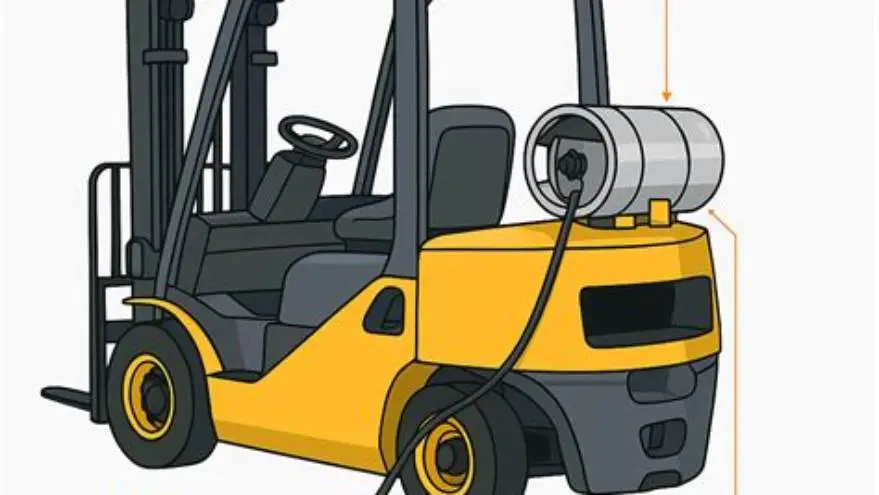
Never treat a grill cylinder as a forklift cylinder. Compatibility depends on the truck manufacturer's approved cylinder, mounting orientation, valve, bracket and liquid-withdrawal arrangement. Check the truck manual, cylinder marking or dealer before fitting another size. If that sounds like your situation, read up on propane uses on the farm next.
How do you measure your forklift's burn rate?
Weigh, work, then weigh again. This measures your truck, operators and duty cycle instead of borrowing a figure from another site. Use a platform or bench scale rated for the complete cylinder weight. Greater resolution gives a better estimate, so choose the finest practical reading for your equipment.
Follow the truck, cylinder and supplier instructions before disconnecting anything. Cylinder handling details vary. A qualified person should perform the work where your site rules require it.
- Copy the TW stamped on the cylinder collar. Record the cylinder's rated propane charge from its marking or supplier information.
- Weigh the cylinder with a properly rated scale. A reading below TW plus the rated charge indicates a partial fill, subject to scale accuracy, temperature and filling error.
- Mount the approved cylinder in the stated orientation. Record the hour meter and use the truck through a normal work period. Keep the duty cycle representative.
- Stop at a planned break before the cylinder reaches the site's minimum safe operating margin. Shut the service valve and disconnect it only as the manual and site procedure direct.
- Weigh the cylinder again. Subtract the later reading from the earlier reading, then divide by engine hours to get pounds used per hour. Convert pounds to gallons only if you need that unit.
- Estimate runtime by dividing the usable charge by measured consumption. Repeat the measurement on a heavier duty cycle if that is how the truck normally works.
A worked example with illustrative numbers
Suppose a cylinder has a TW of 25 lb and weighs 58 lb before work. It weighs 41 lb after four engine hours. The difference is 17 lb, or 4.25 lb per hour. Using about 4.2 lb per gallon gives roughly 1 gallon per hour. A 33 lb charge would then provide about 7.8 hours under that measured pattern.
Those numbers illustrate the method, not a promised result. Hour meters include engine-on time, so idling belongs in the test. Run a separate test during the site's heaviest normal work and use the lower measured runtime for planning.
What makes one truck burn more propane than another?
Duty cycle often makes the biggest difference. Engine size and condition matter too. A truck carrying heavy loads up ramps has a different fuel demand from one making short, light moves.
Idling generally consumes less fuel than loaded operation, but it still uses propane. Long idle periods can make engine-hour comparisons look better than the amount of work completed.
Heavy loads and inclines keep the engine under greater demand. Travel distance, acceleration and hydraulic lifting add work. A clogged air filter, worn plugs, poor adjustment or a regulator problem can raise fuel use.
Two identical trucks can produce different runtimes on the same site. Time the truck doing the heaviest normal work, then compare later tests with that baseline. Investigate when runtime drops noticeably or falls outside the site's normal variation. Ask a qualified technician to check the truck rather than changing fuel-system parts yourself.
- Idling: lower consumption than loaded work, but fuel still leaves the cylinder.
- Load weight: heavier pallets demand more engine and hydraulic work.
- Travel and ramps: longer routes and inclines increase engine load.
- Engine condition: maintenance faults can increase consumption.
- Driving style: harsh acceleration and holding hydraulics against a stop waste fuel.
Is the cylinder empty, or is the truck starving?
A cylinder near its tare weight has little usable liquid. It is not safe to assign an arbitrary pound threshold because scale accuracy, temperature and cylinder markings vary. Follow the equipment or supplier procedure before deciding it is empty or removing it.
A reading below tare plus the rated propane charge indicates a partial fill, subject to scale and temperature error. A reading well above tare suggests fuel remains, so the cause may be elsewhere. Check the manual before troubleshooting the valve, regulator or mounting.
Cold weather lowers propane vapor pressure. A nearly empty cylinder can struggle more in cold conditions because less liquid remains to supply vapor. Use a propane pressure-temperature table for the actual gas mixture if pressure data matters. Do not use a pressure guess as a fuel gauge.
If the truck loses power, surges or stalls with fuel remaining, stop and follow the truck manual. An excess-flow device, regulator, valve, pickup arrangement or incorrect mounting may be involved. A qualified propane technician should inspect repeated faults.
| What you see | Possible cause | What to do |
|---|---|---|
| Stalls while the cylinder remains well above tare | Fuel-system restriction, excess-flow response or regulator fault | Close the area and follow the truck manual or call a qualified technician |
| Stalls during slopes or turns | Incorrect cylinder orientation, mounting or liquid-withdrawal position | Stop work and verify the approved cylinder and mounting procedure |
| Problem appears mainly in cold weather | Lower vapor pressure, low fuel level or regulator icing | Use the manual and supplier procedure. Call a qualified technician if it repeats |
| Gauge and scale disagree | Float gauge reading affected by tilt or a faulty gauge | Park level, compare with the approved weighing procedure and have faults checked |
How do you read the gauge on a forklift cylinder?
A float gauge gives an approximate liquid level. Read it with the truck level and treat it as a rough indication, not an hour counter. The gauge and cylinder design can vary.
A fixed liquid-level device is used during filling under the supplier's procedure. It does not provide a continuous fuel reading. Do not operate or alter it unless the equipment instructions specifically allow it.
How many spare cylinders do you need?
Use your measured minimum runtime and the shift length. Divide the required engine hours by that minimum, then round up to a whole cylinder count. Add site-selected spare capacity for delivery schedules, shared trucks, breaks or unusual workloads.
Schedule swaps before the measured minimum runtime, leaving a safety margin chosen by your site. Pick a break or safe stopping point rather than waiting for a stall. Store cylinders only as permitted by the truck manual, supplier instructions, fire code and local authority.
Cylinder storage and handling rules depend on location and quantity. Follow the applicable code, such as NFPA 58 where adopted, plus your local fire marshal's requirements. Keep cylinders secured and protected as the storage rules require.
A 20 lb forklift cylinder contains less propane than a 33 lb charge, so it usually provides fewer hours under the same duty cycle. The exact difference comes from the approved charge and measured burn rate. Use a 20 lb cylinder only when the truck manufacturer approves it.
Wear the protective equipment required by your site procedure during a swap. Check the connection using the approved leak-check method. Never substitute a grill cylinder, different valve or unapproved bracket.
| Approved cylinder charge | Approximate propane volume | Runtime at 1.0 gal/h |
|---|---|---|
| 20 lb | about 4.7 gal | about 4.7 hours |
| 33 lb | about 7.8 gal | about 7.8 hours |
- Lower lifting weight when approved
- May suit a truck designed for the smaller cylinder
- Less propane per approved charge
- More frequent swaps under the same duty cycle
Key points
- Schedule cylinder swaps before your measured minimum runtime, leaving a safety margin your site chooses.
- A cylinder's nominal size is not the same as its propane charge or usable runtime.
- Weighing before and after a normal work period gives a site-specific fuel-use figure.
- A cylinder near tare weight has little usable liquid. Follow the truck or supplier procedure before removing or handling it.
- Use only the cylinder approved for the truck, including its size, valve, mounting direction and liquid-withdrawal design.
People also ask
Does running a forklift out of propane damage the engine?
Follow the truck manual. The immediate hazard is an unexpected stop with a raised load or in a traffic lane. Swap cylinders before the measured minimum runtime and use the approved restart procedure.
Does the truck lose power as the cylinder drains?
A gradual loss is not a reliable fuel gauge. Weigh the cylinder and follow the manual if the truck feels weak. Fuel-system, regulator, mounting and cold-weather problems can look like low fuel.
How often should I re-time the burn rate?
Repeat the test after engine or fuel-system service, after a major duty-cycle change and when runtime drops noticeably or falls outside normal site variation. Seasonal testing can help where cold weather changes operation.
Can I put a bigger cylinder on a truck to get more hours?
Only if the manufacturer approves the cylinder, charge, bracket, valve, orientation and liquid-withdrawal arrangement. Ask the dealer or read the truck manual before making a change.