Propane autogas vehicles: the fuel price gap that repays the upfit
The pros and cons of propane autogas vehicles reduce to three numbers: price gap, upfit cost and annual miles. A gallon holds 20-25% less energy than gasoline, so propane must cost under 75-80% as much to tie. Return-to-base fleets above 30,000 miles a year fare best.
Part of our guide on propane heaters
Propane Facts
- Propane energy
- About 91,500 BTU per gallon
- Versus gasoline
- 20-25% less energy per gallon
- Propane mpg estimate
- 76-80% of gasoline mpg
- Break-even price
- 0.75-0.80 x gasoline price
- Usable tank fill
- About 80% of tank volume
- Fuel weight
- About 4.2 lb per gallon
- Boiling point
- About -44 F
Contents8 sections
- How much less energy does a gallon of propane hold?
- How do you calculate cost per mile for each fuel?
- How many miles a year does it take to repay the upfit?
- Where do you fuel: public stations or your own tank?
- Propane autogas vehicles pros and cons: what can break the payback?
- Which fleets fit autogas, and what should you confirm first?
- Key points
- People also ask
How much less energy does a gallon of propane hold?
Every list of propane autogas vehicles pros and cons starts with energy. A gallon of propane carries about 91,500 BTU. Gasoline holds roughly 114,000 to 120,000 BTU per gallon, depending on the blend. Diesel holds roughly 129,000 to 138,000. That leaves propane 20-25% below gasoline and about 30-35% below diesel.
Your engine turns fuel into motion at about the same efficiency either way, so less energy per gallon means fewer miles per gallon. A truck that gets 15 mpg on gasoline will usually return about 11-12 mpg on propane. Real vehicles vary with calibration, load and driving pattern. Treat 76-80% as a planning range, not a promise. Brochure fuel economy rarely matches your route, so measure your own.
Plenty of buyers assume a cheaper gallon means a cheaper mile. It doesn't. The pump compares volume, and you pay for energy. At $3.50 gasoline, a propane price $1 lower is only about $0.30 cheaper once you count energy. Fuel-program paperwork may also quote 'gasoline gallon equivalents' with its own conversion factor, so check which one a quote uses. Pull your last three fuel receipts, work out your real mpg, and multiply by 0.76 to 0.80 for a first guess at propane.
| Fuel | BTU per gallon | Propane gallon holds this share |
|---|---|---|
| Propane (HD-5) | About 91,500 | 100% |
| Gasoline | 114,000-120,000 | 76-80% |
| Diesel | 129,000-138,000 | 66-71% |
How do you calculate cost per mile for each fuel?
Cost per mile is the price per gallon divided by miles per gallon. Work it out once for your current fuel and once for propane, then subtract. The steps below use your own numbers. We go through propane uses on the farm step by step elsewhere on the site.
Try it with made-up prices. Gasoline at $3.50 per gallon and 15 mpg costs $3.50 ÷ 15 = 23.3 cents per mile. At 80% of the energy, propane gets 12 mpg. Propane at $2.20 per gallon costs $2.20 ÷ 12 = 18.3 cents per mile. The saving is 5.0 cents per mile.
Notice what happened to the price gap. The pump shows $1.30 per gallon. Propane only ties gasoline at $2.80 ($3.50 × 0.8), so just the last $0.60 of the gap earns money. Spread over 12 miles per gallon, that $0.60 is your 5 cents.
Diesel comparisons need a lower factor. Propane's mpg often lands near 55-65% of a diesel truck's, because diesel engines also use fuel more efficiently. Ask the upfitter for measured figures from a similar vehicle on similar work. Then run the five steps on your own prices before you call anyone. The other half of this decision is the price per gallon where propane wins.
- Fill the tank and write down the odometer. Drive normally, fill again, and divide miles driven by gallons added. Average three fill-ups.
- Divide your fuel price per gallon by that mpg. The result is your current cost per mile.
- Multiply your mpg by 0.76 to 0.80 for estimated propane mpg, or use a measured figure from the upfitter.
- Divide the delivered propane price per gallon, taxes included, by the propane mpg.
- Subtract the second result from the first. The difference is your saving per mile.
How many miles a year does it take to repay the upfit?
Multiply the saving per mile by annual miles, then divide the upfit by the result. The table uses the 5.0-cent saving from the example and a $9,000 upfit. That figure is a placeholder, not a quote.
Payback fails whenever it runs longer than you'll keep the vehicle. A truck that drives 10,000 miles a year and sells at year 8 never repays here. Miles are the biggest lever. At 30,000 miles the same truck repays in 6 years, and at 60,000 in 3.
Gaps move, so test the math at a saving half as large. Propane and gasoline prices rise and fall independently. At 30,000 miles, half the saving means 12 years instead of 6. A wider gap helps just as fast: at $1.80 propane the saving is 8.3 cents per mile, which repays the same upfit in 3.6 years. We go through how many hours, and why yours runs short step by step elsewhere on the site.
Upfit cost swings with engine size, vehicle class and system type. Quotes commonly run to several thousand dollars per vehicle, and larger engines cost more. Get two written quotes and compare the items below. Then rerun the table with the real price and your real mileage.
- Certification: ask for the EPA or state certificate covering your engine family and model year.
- Inclusions: tanks, lines, mounts, labor and first fill, itemized.
- Warranty: written confirmation from the vehicle maker about your powertrain coverage.
- Weight: empty tank weight and usable gallons per tank.
- Measured economy: mpg from a similar vehicle on similar work.
| Annual miles | Yearly saving | Years to repay |
|---|---|---|
| 10,000 | $500 | 18 |
| 20,000 | $1,000 | 9 |
| 30,000 | $1,500 | 6 |
| 40,000 | $2,000 | 4.5 |
| 60,000 | $3,000 | 3 |
Where do you fuel: public stations or your own tank?
Public autogas stations are thin in many areas, so check your routes first. Use a station locator, such as the one from the Department of Energy's Alternative Fuels Data Center. Then mark every stop your vehicles would need. A vehicle with no station inside its range has no business being converted.
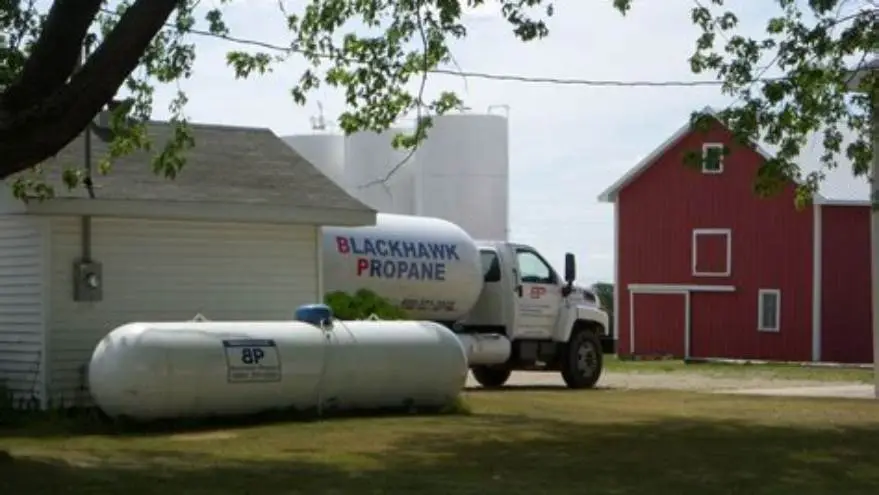
Fleets with a yard usually fill from an on-site tank. A propane supplier often owns the tank and dispenser and rents them to you, with a delivery contract attached. Ownership and terms vary. Ask who owns the tank, who services the dispenser, and who pays when either fails.
Siting is regulated. NFPA 58, the LP-gas code, sets distances from buildings, property lines and traffic. Your local fire marshal usually has to approve the location. Permits take time, so start before you order the upfit.
Contract terms shape the payback as much as the upfit does. Look for minimum volumes, term length, the price formula and the fee to remove the tank if you leave. Ask whether the per-gallon price you were quoted includes road-fuel taxes. A price without them overstates your saving. Ask the supplier for a draft contract and read the removal fee and minimum volume lines first.
Propane autogas vehicles pros and cons: what can break the payback?
Range is the drawback you'll feel first. Propane tanks fill to about 80% of their volume, leaving room for the liquid to expand. A 30-gallon tank gives about 24 usable gallons. At 12 mpg that's roughly 290 miles, against about 390 for a 26-gallon gasoline tank at 15 mpg. Bi-fuel systems keep the gasoline tank, which restores range but leaves two fuel systems to maintain.
Placement costs you something. A tank in the bed eats cargo space, an under-body tank cuts ground clearance, and a tank in the spare-tire well may mean carrying no spare. Fuel weighs about 4.2 lb per gallon, so 24 gallons is roughly 100 lb before you add the empty tank. Find your payload on the sticker in the driver's door jamb and subtract the tank weight the upfitter gives you.
Cold changes how the fuel behaves. Propane boils at about -44 F, and tank pressure falls with temperature: roughly 25 psi at 0 F against over 100 psi at 70 F. Older vapor-feed systems can start hard on a cold morning. Modern liquid-injection systems use an in-tank pump to hold pressure, and some bi-fuel setups start on gasoline first. Ask which one you're buying, and ask the supplier about winter fuel blends.
Indoor parking needs thought. Propane vapor is heavier than air and collects low in a closed shop. Check local fire code first, and never run any engine in a closed garage because of carbon monoxide. A propane alarm mounted within about 12 inches of the floor gives early warning of a weeping fitting.
- cost per mile falls if the gap is wide
- oil stays cleaner, per some fleets
- one depot tank sets your fuel supply
- 20-25% fewer miles per gallon
- about 290 miles per fill in the example
- tank takes cargo space or clearance
- few public stations in many areas
Which fleets fit autogas, and what should you confirm first?
Return-to-base fleets with high daily mileage fit best. One yard means one tank, and steady miles are what repay the upfit. Use the table as a first filter, then run your own numbers.
Maintenance is contested. Some fleets report cleaner oil because propane causes less fuel dilution. Others warn that dry fuel can wear valve seats on older engines without hardened seats. Ask the upfitter for the service schedule on the vaporizer, filters and fuel lines, and whether your engine needs hardened seats or an additive.
Emissions claims are usually made against diesel, and they depend on the engine and its certification. Ask for the certification data for your engine and model year, not a general statement.
Incentives change often. Federal alternative-fuel credits have lapsed and been renewed before, so check current status with the Alternative Fuels Data Center, your state energy office and your local air district. Confirm whether a program covers conversions or only new vehicles, and whether it sets a deadline. Get the maintenance schedule, the certification and the incentive terms in writing before you pay.
| Fleet type | Fit | Reason |
|---|---|---|
| Delivery vans, shuttles, taxis | Strong | High daily miles, one depot |
| Municipal and utility trucks | Mixed | Return to base, but idling and short trips cut miles |
| School buses | Mixed | Depot fueling and fixed routes, modest annual miles |
| Farm and ranch pickups | Weak | Low miles, long hauls to the nearest station |
| Long-haul or mixed-route trucks | Poor | No stations along the route |
Worth it for high-mileage vehicles that refuel at one depot; for low-mileage farm and personal trucks the math usually fails.
Key points
- Compare cents per mile, not dollars per gallon, and use mpg from your own fuel receipts.
- Only the part of the price gap below the break-even price pays for the upfit.
- Get two written quotes that list certification, tank weight and what is included.
- Count autogas stations on your routes, or confirm a depot tank, before you spend anything.
- Subtract the tank's weight from the payload sticker in the driver's door jamb.
People also ask
Can I convert my own truck to run on propane?
Only with a conversion system that is certified or exempt under EPA rules and your state's, installed by a qualified shop. Ask for the certificate covering your engine family and model year. An uncertified kit can bring emissions-law problems and complicate warranty claims.
Is propane cheaper than diesel per mile?
Rarely by default. Propane's mpg can land at 55-65% of a diesel truck's, so its per-gallon price would need to sit near or below 55-65% of diesel to tie. Use your own diesel mpg in the five steps to get your number.
What happens to resale value on a converted vehicle?
I can't give a figure, and it varies by market. A converted vehicle appeals to fewer buyers. Ask local dealers and the upfitter whether the system can be removed or transferred, and whether warranty coverage follows the vehicle.
Does cold weather cut propane mileage?
Expect some drop, as with any fuel, and measure it. Cold air, longer warm-ups and winter fuel blends all play a part. Log mpg over one winter on a test vehicle before you convert a whole fleet.
Is autogas the same propane I use in a grill?
Engine-fuel propane is specified as HD-5, and much US supply is the same grade as grill and heating propane. The difference is the equipment. Vehicles fuel through dedicated dispensers with trained operators, and road-fuel taxes apply.