Propane tankless water heater pros and cons: is one right for your home?
Propane tankless water heaters can provide continuous hot water and reduce standby losses, but they cost more to install and need a correctly sized fuel system. The right choice depends on your hot-water demand, propane tank arrangement, gas piping, water conditions, climate, and installation location.
Part of the guide: Propane water heater use: estimate gallons from BTU and run time
Propane Facts
- Typical whole-house input
- Check the specific model, often substantially higher than tank-style input
- Propane energy content
- About 91,500 BTU per gallon
- Minimum tank size
- No universal minimum can be set from BTU rating alone
- Minimum activation flow
- Model-specific; check the installation manual
- Peak hot-water supply
- Limited by burner capacity, flow rate, and temperature rise
- Expected service life
- Depends on model, water quality, installation, and maintenance
Contents9 sections
- What are the main propane tankless water heater pros and cons?
- Can your propane tank supply the heater in cold weather?
- What gas pressure and line size does a propane tankless heater need?
- How much propane will a tankless water heater use each year?
- How do flow and temperature rise limit hot water?
- Where can you install a propane tankless water heater?
- What maintenance does a propane tankless heater need?
- Key points
- People also ask
What are the main propane tankless water heater pros and cons?
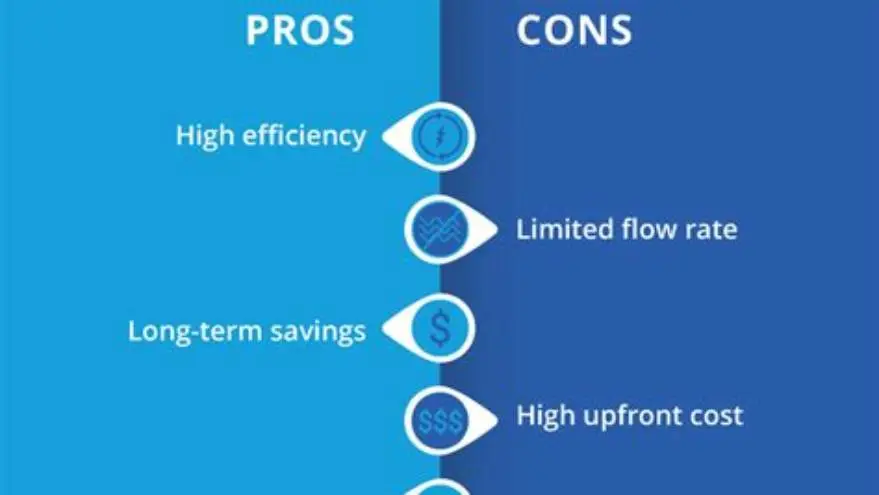
The main advantages are continuous hot water, less floor space, and no tank standby loss. A tankless heater warms water only as you use it, so it can reduce fuel use in some homes.
The main drawbacks are higher installation cost, high peak gas demand, flow limits, electrical dependence, and regular maintenance. Hot water is not literally unlimited. Burner capacity and flow rate still set the ceiling.
Many whole-house tankless models have substantially higher peak input than tank-style heaters; compare the specific models' input ratings. A model's input rating shows the maximum fuel energy entering the burner, not the amount of hot water it can deliver in every situation.
Propane contains about 91,500 BTU per gallon. A unit drawing 199,000 BTU per hour would use about 2.2 gallons per hour at full input, before accounting for cycling and efficiency. That is a peak-use calculation, not an annual consumption estimate. Before you commit to anything, it is worth looking at gas or electric laundry.
| Spec | What to check | Why it matters |
|---|---|---|
| Input rating | The model's listed maximum BTU/h | Shows peak gas demand |
| UEF | The named model's manufacturer-listed UEF | Helps compare modeled efficiency |
| Minimum flow | The activation flow in the manual | Low-flow fixtures may not start the burner |
| Maximum flow | The flow at a stated temperature rise | Shows the usable output in your climate |
| Vent and drain | Vent category, materials, condensate, and drain requirements | Affects installation cost and location |
| Electrical needs | Voltage, amperage, and outage behavior | Controls whether the heater works during outages |
| Maintenance | Descaling interval and service requirements | Water quality can change ongoing cost |
- Continuous hot water while demand stays within the unit's output
- Less floor space than a storage tank
- No storage-tank standby loss
- Potentially lower modeled fuel use in some homes
- Higher purchase and installation cost
- High peak gas demand
- Limited flow at high temperature rise
- Needs electrical power and regular maintenance

6699 Tankless Water Heater Cleaning Kit
For your tankless water heater maintenance, this kit includes the 1/6 HP pump, two 6 ft hoses, 3 gal pail, and a bottle of cleaner so you can flush scale without buying separate parts.
Can your propane tank supply the heater in cold weather?
Propane changes from liquid to vapor inside the tank before reaching the appliance. Vaporization capacity depends on the tank design, liquid level, temperature, and total connected load.
Ask the propane supplier to check the tank manufacturer's table or applicable industry table. The review should use your tank, design temperature, and connected load. Keep the tank above the supplier's recommended delivery level. Arrange deliveries before the liquid level becomes low.
A larger tank or multiple tanks may provide more capacity. Your supplier must size the arrangement from the tank specifications and design temperature. The heater's BTU rating alone cannot establish a universal minimum tank size. There is more on estimating hours from fuel-use data in a separate guide.
Heavy or persistent frosting can show substantial cooling during propane withdrawal. Frosting does not identify the exact fault. Contact the propane supplier if the heater loses pressure or the tank frosts heavily.
What gas pressure and line size does a propane tankless heater need?
Your tank, regulators, piping, and fittings must deliver the pressure listed in the heater manual. Each model has a specific inlet-pressure range. Check its minimum and maximum limits, not just the pipe diameter.
The installer needs the tank pressure, regulator setup, pipe material, run length, fittings, allowable pressure drop, elevation, and total appliance load. The applicable fuel-gas code table or manufacturer instructions then determine the pipe size.
List the furnace, range, dryer, fireplace, and water heater before sizing the line. The system must work while other appliances operate. A larger connection at the heater cannot fix an undersized run or inadequate regulator.
How much propane will a tankless water heater use each year?
Peak input and annual fuel consumption answer different questions. Peak input tells you whether the supply can serve the burner at one moment. Annual consumption depends on how much hot water you use and how efficiently the appliance heats it.
You can estimate annual propane use from hot-water volume. Use this method: gallons of water multiplied by 8.34 pounds per gallon, multiplied by the temperature rise in degrees Fahrenheit, gives BTUs delivered to the water. Divide by the heater's efficiency and by about 91,500 BTU per gallon of propane.
Example: assume 60 gallons of hot water per day, incoming water at 55°F, and a 120°F set point. The temperature rise is 65°F. Daily delivered heat is 60 × 8.34 × 65, or about 32,500 BTU. At a hypothetical 0.95 efficiency, fuel input is about 34,200 BTU per day, or about 136 gallons of propane per year.
That example is deliberately hypothetical. Change the daily gallons, incoming temperature, set point, efficiency, and propane price for your home. Add reasonable allowance for pipe losses, recirculation, and standby use if the model or system has them.
A higher rated efficiency can reduce modeled fuel use, but annual consumption depends on hot-water demand, incoming-water temperature, set point, cycling, and the specific models being compared. Compare named models using their manufacturer-listed UEF values. UEF is a test metric, not a promise of your household's yearly result.
A simple cost estimate multiplies the calculated gallons by your delivered propane price. Compare that result with the matching calculation for a tank-style heater, electric heater, or natural-gas model. Use the same hot-water demand for each comparison.
How do flow and temperature rise limit hot water?
Tankless units need a minimum flow to activate and a maximum flow they can heat to a selected temperature. Both figures vary by model. A faucet that flows below the activation threshold may produce cold water or cause repeated burner cycling.
Temperature rise is the difference between incoming cold water and the target temperature. If groundwater enters at 40°F and the target is 120°F, the heater must raise it 80°F. Warmer incoming water requires less burner output for the same flow.
A high-flow shower or two fixtures running together can exceed the unit's output at a large temperature rise. The heater then limits flow, delivers cooler water, or needs a lower set point. Check the performance chart, not only the maximum gallons-per-minute headline.
Small cylinders and RV appliances must be evaluated against the appliance manual and the cylinder's calculated vaporization capacity. Do not treat a small cylinder as a whole-house supply without that calculation.
Where can you install a propane tankless water heater?
Outdoor and indoor models have different installation needs. An outdoor unit avoids indoor combustion air and often simplifies venting. Its water lines and heat exchanger still need freeze protection. Follow the manual for power, insulation, drainage, and protection requirements.
An outdoor heater can freeze during a power outage. The same can happen if its built-in protection loses electricity. A drain-down plan, backup power, or another approved safeguard might be required. Don't assume the burner protects standing water.
Indoor models need approved venting, combustion-air arrangements, and required clearances. Some condensing units also need a condensate drain. Their vent materials can differ from non-condensing models. The installation manual sets the allowed route, materials, and termination points.
Sealed direct-vent combustion reduces reliance on indoor air. It doesn't remove clearance or code requirements. Gas work, venting, permits, and inspections vary by jurisdiction. Check local rules and hire a qualified installer when required.
What maintenance does a propane tankless heater need?
Scale can reduce performance and damage some heat exchangers. Test your water hardness, then follow the manufacturer's descaling interval. Hard water often requires more frequent service. Sediment can also restrict flow, so clean the inlet filter as the manual directs.
Service steps vary between models. Your manual may specify a flushing solution, pump time, isolation valves, filter cleaning, or technician service. Shut off the fuel and water supplies before servicing. Follow the stated procedure instead of guessing.
Keep a service record with dates, water conditions, and any fault codes. That record helps you connect changes in flow or temperature with maintenance. Arrange a combustion and venting inspection if the unit shows unusual flame behaviour, soot, exhaust odour, or repeated shutdowns.
Natural-gas and propane models aren't automatically interchangeable. A natural-gas unit needs manufacturer-approved conversion parts, correct orifices, regulator adjustments, and combustion checks before propane use. Confirm the fuel type before buying a used unit.
A propane tankless water heater can suit a home that wants continuous hot water and has a properly sized fuel system. It is less attractive when installation work is expensive, water is hard, electrical backup is unreliable, or the household rarely uses enough hot water to recover the added cost.
Key points
- Many whole-house tankless models have substantially higher peak input than tank-style heaters; compare the specific models' input ratings.
- Cold weather and a low liquid level can reduce a tank's vaporization capacity. Have the propane supplier check the tank manufacturer's or applicable industry table for your tank, design temperature, and connected load.
- A higher UEF can reduce modeled fuel use, but annual consumption depends on hot-water demand, incoming-water temperature, set point, cycling, and the specific models being compared.
- Tankless units need enough flow and burner capacity to reach your selected temperature. Cold incoming water can reduce the flow available at a given temperature rise.
- Installation costs, permits, venting, condensate drainage, gas work, and maintenance can delay or erase fuel-cost savings.
- Scale can reduce performance and damage some heat exchangers. Test or measure water hardness and follow the manufacturer's descaling interval; harder water may require more frequent service.
People also ask
Can I install a propane tankless water heater myself?
Gas work, venting, permits, and inspection requirements vary by jurisdiction. Check local code and use a qualified, permitted installer where required. Water connections may be within a skilled DIYer's ability, but the manual and local rules control the work. Improper gas or vent work can cause leaks, fire, carbon monoxide exposure, failed inspection, or warranty problems.
How do I know if my existing gas line is big enough?
Give the installer the heater's maximum input and a list of every appliance on the system. The installer should check pipe material, diameter, run length, fittings, inlet pressure, allowable pressure drop, and the applicable code table. The result must cover the combined connected load while other appliances operate.
What is the cold-water sandwich, and can it be reduced?
A cold-water sandwich is a brief temperature change between separate draws. Residual water in the pipes can arrive before the burner starts heating the next draw. A properly designed recirculation or buffer-tank system can reduce temperature swings; follow the heater manufacturer's compatibility and control requirements.
Does a propane tankless unit work during a power outage?
Many whole-house models need electricity for controls, ignition, sensors, and freeze protection. Some models have different outage behavior, so check the manual. A generator or battery system must also meet the manufacturer's electrical requirements before it can provide useful backup.
How much propane does a tankless unit use per year?
Calculate gallons of hot water per day × 8.34 × temperature rise, then divide by the heater's efficiency and about 91,500 BTU per gallon of propane. Multiply the daily result by your operating days. Replace the assumptions with your measured water use, incoming temperature, set point, model efficiency, and propane price.
Can a propane tankless heater serve an entire house with a 250-gallon tank?
A 250-gallon tank may be adequate in some installations, but adequacy must be confirmed from the specific tank's vaporization rating at the local design temperature and total connected load. Ask the propane supplier to evaluate the tank, liquid level, temperature, heater input, and other appliances together.