20 lb propane tank on a generator: hours, and when it can't keep up
How long will a generator run on a 20 lb propane tank? Divide the cylinder's rated propane quantity by the generator's propane consumption at your actual connected load. A 20 lb fill contains more fuel than a 15 lb exchange fill, but cold weather, low liquid level, and vaporization limits can shorten practical runtime.
Propane Facts
- Nominal full cylinder
- About 20 lb of propane
- Common exchange fill
- About 15 lb, but check the label
- Basic runtime calculation
- Propane quantity ÷ propane use per hour
- Half-load example
- 12 hours, using hypothetical figures
- Full-load example
- 7 hours, using hypothetical figures
- Main cold-weather warning
- Vapor supply depends on the cylinder and operating conditions
Contents9 sections
- How much propane is in a 20 lb cylinder or an exchange cylinder?
- How long will a generator run on a 20 lb propane tank?
- How do you calculate runtime from a 20 lb cylinder?
- Why can a cylinder struggle in cold weather?
- How can you check the propane left during a run?
- When should you use two cylinders or a larger cylinder?
- How do you connect or disconnect the cylinder safely?
- Key points
- People also ask
How much propane is in a 20 lb cylinder or an exchange cylinder?
A nominal 20 lb cylinder is commonly filled with about 20 lb of propane, with the container limited to roughly 80% liquid fill to allow for thermal expansion. The 80% rule concerns empty space inside the cylinder. It does not mean 20% of the propane is automatically unusable.
Exchange cylinders often contain about 15 lb of propane, though the actual fill varies by brand and location. Check the label or collar instead of assuming every cylinder contains 20 lb. The steel container may look identical while holding less fuel.
Use the rated propane quantity for your calculation. Don't apply a fixed deduction for fuel you assume the generator cannot use. Low liquid level, cold weather, and vaporization limits can shorten the practical result later.
A 15 lb exchange fill gives 75% of the propane in a 20 lb fill. At the same fuel-consumption rate, its calculated runtime is also about 75% as long. The other half of this decision is how long does propane last in an rv.
| Cylinder fill | Propane quantity | Runtime comparison at the same load |
|---|---|---|
| Nominal full cylinder | About 20 lb | Baseline |
| Common exchange fill | About 15 lb | About 75% of the 20 lb runtime |
| Actual cylinder | Read the label | Use the labeled quantity |
How long will a generator run on a 20 lb propane tank?
Use the generator's propane-consumption figure at your actual connected load. Find it in the manual, data sheet, or product specifications. The figure may appear as pounds per hour, gallons per hour, or cubic feet per hour.
A 20 lb cylinder contains a stated propane quantity, but runtime depends on usable fuel and consumption. Divide the propane quantity by the generator's consumption rate. A generator using 1 lb per hour would have a simple estimate of 20 hours, before temperature and supply limits enter the calculation.
Choose the test row closest to your appliance load. Rated output is the most power the generator can provide continuously. It isn't the power your appliances always draw. A 3,500-watt rating does not mean the generator consumes fuel as though it supplies 3,500 watts every hour. The other half of this decision is propane vs electric dryer.
Starting surges can briefly raise demand from refrigerators, pumps, or other motors. Load changes can shift the average consumption too. Cold weather, maintenance, regulator condition, and cylinder temperature can also change the result.
Some specifications provide only one propane figure. Treat it as a result under stated test conditions, not a promise for every outage. Check the listed load, temperature, fuel, and test setup before using it for your estimate.
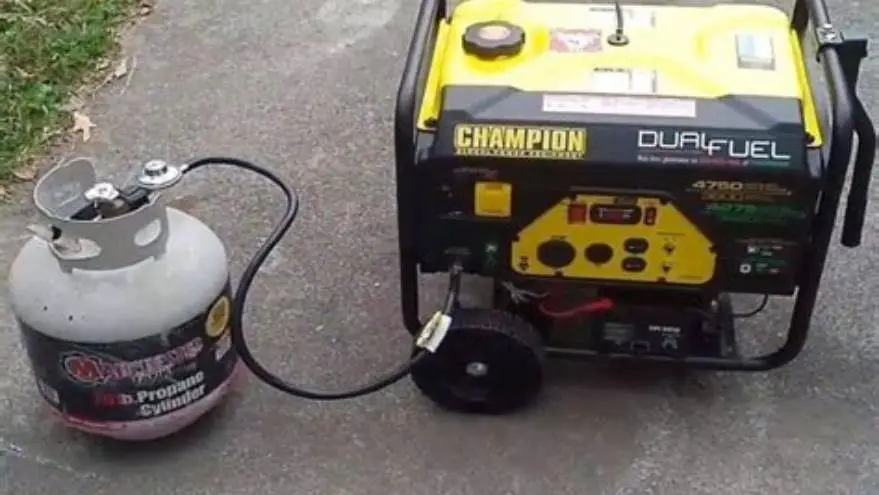
A propane-rated generator may accept a 20 lb cylinder, but the manual controls the safe setup. Use only the specified hose, regulator, connector, and cylinder arrangement. A correct fuel calculation cannot fix an incompatible connection.
- Use the consumption rate nearest your connected load.
- Check whether the figure uses pounds, gallons, or cubic feet per hour.
- Account for starting surges and changing appliance loads.
- Follow the manual's hose, regulator, and cylinder requirements.
How do you calculate runtime from a 20 lb cylinder?
Start with the propane quantity printed on the cylinder or exchange label. Then divide it by the generator's published propane use at your connected load. Keep the units consistent, such as gallons divided by gallons per hour or pounds divided by pounds per hour.
Here is a rough example only. Suppose a hypothetical generator uses 0.35 gallons per hour at a stated half-load test and 0.60 gallons per hour at a stated full-load test. Those figures are not a substitute for a real generator's specifications.
A 20 lb propane fill contains roughly 4.7 gallons using common propane-density estimates. The example calculation is 4.7 divided by 0.35, or about 13 hours at the stated half-load test. At the hypothetical full-load rate, 4.7 divided by 0.60 gives about 8 hours.
A 15 lb exchange fill contains roughly 3.5 gallons using the same estimate. Its calculation is 3.5 divided by 0.35, or about 10 hours at the hypothetical half-load test. At 0.60 gallons per hour, it gives about 6 hours.
These results are planning examples, not operating guarantees. Don't replace your generator's published consumption data with 0.35 or 0.60 gallons per hour. A different engine, load, regulator, or test condition can produce a different result.
- Read the propane quantity on the cylinder label.
- Find the generator's propane use at your actual connected load.
- Convert both figures to matching units.
- Divide propane quantity by consumption per hour.
- Treat the answer as an estimate and allow for changing load and conditions.
Why can a cylinder struggle in cold weather?
A vapor-use cylinder supplies gas from propane boiling inside the container. Heat moves through the cylinder wall to support that boiling. Cold air, a low liquid level, cylinder design, and regulator pressure can reduce the rate available to the generator.
Allowable vapor withdrawal varies with temperature, liquid level, cylinder design, and regulator pressure. No single capacity number applies to every 20 lb cylinder. Use the vapor-withdrawal table supplied by the cylinder manufacturer, propane supplier, or generator manufacturer for your exact setup.
The same table should state its conditions, such as ambient temperature and allowable pressure drop. If a numerical capacity is not published for your cylinder, ask the supplier rather than relying on a generic internet range.
Frost or heavy sweating on the lower cylinder wall can show the container is cooling while supplying gas. Engine surging, falling output, or a shutdown under load can point to a supply problem. Reduce the electrical load and let the equipment stabilize.
Never warm a cylinder with a flame, torch, heater, or improvised device. Keep the cylinder upright and unobstructed. Operate the generator outdoors with exhaust directed away from doors, windows, vents, crawl-space openings, and other openings.
- Frost or heavy sweat appears on the cylinder during operation.
- The engine speed hunts when you add a load.
- The generator loses output after running under a heavy load.
- The engine stops while propane remains in the cylinder.
How can you check the propane left during a run?
A pressure gauge usually cannot tell you how much liquid propane remains. Pressure changes with temperature and often stays similar while liquid fuel remains. A scale gives a better estimate without relying on line pressure.
Find the cylinder's tare weight, marked as TW on the collar or handle. Place the scale beside the running equipment before lifting anything. Don't pull on, twist, loosen, or support the hose and regulator while weighing the cylinder.
The safer method is to stop the generator, shut the cylinder valve, and follow the manufacturer's procedure for weighing that specific arrangement. If the cylinder must be disconnected, or the procedure is not explicitly user-serviceable, have a qualified propane technician do it.
Some setups allow the connected cylinder to sit on a platform scale without disturbing the fittings. Use that method only if the equipment remains upright, stable, and fully supported, and the manual permits it. Never suspend a connected cylinder from a scale if the hose or regulator carries its weight.
Subtract the tare weight from the total cylinder weight. The result is an estimate of pounds of propane remaining. Divide that amount by the generator's published pounds-per-hour figure for your load.
- Stop the generator and shut off the cylinder valve.
- Follow the manual's procedure for the specific connector and cylinder arrangement.
- Keep the cylinder upright and supported without putting strain on fittings.
- Read the total weight without loosening or disturbing propane connections.
- Subtract the stamped TW value from the total weight.
- Divide the remaining propane weight by the published consumption rate in pounds per hour.
When should you use two cylinders or a larger cylinder?
Use a larger fuel supply when the calculated runtime is too short or the approved setup cannot supply enough vapor. Two properly connected cylinders usually provide about twice the fuel and may increase vaporization capacity, but the actual capacity must be checked against the regulator, hose, and manufacturer's instructions.
Two cylinders do not automatically make every arrangement safe or compatible. Use only the dual-cylinder hose, changeover device, regulator, and cylinder sizes named by the generator or propane-system manufacturer. A qualified propane technician should handle any connection not explicitly described as user-serviceable.
A larger cylinder can provide more fuel in one container, but its fittings and regulator must still match the generator. Keep every cylinder upright, secure, outdoors, and protected from vehicle impact or other damage.
Calculate the runtime from the total rated propane quantity only after confirming the complete fuel arrangement. Then check the vapor-withdrawal information for the coldest conditions you expect.
| Setup | Rated propane quantity | Calculation at 0.35 gal/h | Result |
|---|---|---|---|
| One 20 lb fill | About 4.7 gal | 4.7 ÷ 0.35 | About 13 hours |
| One 15 lb exchange fill | About 3.5 gal | 3.5 ÷ 0.35 | About 10 hours |
| Two 20 lb fills | About 9.4 gal | 9.4 ÷ 0.35 | About 27 hours |
| One 40 lb fill | About 9.4 gal | 9.4 ÷ 0.35 | About 27 hours |
How do you connect or disconnect the cylinder safely?
Shut off both the generator and the cylinder before handling the fuel connection. Follow the manual's procedure for the specific connector, regulator, hose, and cylinder valve.
Don't assume a grill hose or a familiar fitting is suitable for a generator. If the manual does not explicitly describe the connection as user-serviceable, have a qualified propane technician handle it.
Check for damage, keep the cylinder upright, and never test for leaks with a flame. Use the leak-check method specified for the equipment. Stop if you smell propane or hear gas escaping, move away from ignition sources, and contact a qualified technician or emergency service as appropriate.
Key points
- Use the generator's propane-consumption figure for your actual connected load. Its rated electrical output is not the same as the load you connect.
- A nominal 20 lb cylinder is commonly filled with about 20 lb of propane, with the container limited to roughly 80% liquid fill to allow for thermal expansion.
- A 15 lb exchange cylinder contains about three-quarters as much propane as a 20 lb fill, so its calculated runtime is about three-quarters as long at the same load.
- Treat worked numbers such as 0.35 and 0.60 gallons per hour as hypothetical examples. Don't substitute them for your generator's specifications.
- Frost, engine surging, or falling output can indicate a vaporization or supply problem. Reduce the load and check the approved setup.
- Operate the generator outdoors with exhaust directed away from doors, windows, vents, and other openings.
People also ask
Can I run a generator from the same 20 lb cylinder I use on my grill?
A generator rated for propane may be compatible with a 20 lb cylinder, but use only the connection, regulator, and cylinder arrangement specified in its manual. Don't share a cylinder or fitting unless the approved setup allows it. Keep the cylinder upright and outdoors.
How do I work out my electrical load?
Add the running watts of appliances operating at the same time. Include the largest starting surge from a motor or compressor, then compare the total with the generator's propane running-watt rating. The rating is the generator's capacity, not your usual connected load.
Does an exchange cylinder deliver vapor worse than a refilled one?
The main difference is fuel quantity. A common exchange fill contains about 15 lb, while a nominal full cylinder contains about 20 lb. Vapor supply still depends on temperature, liquid level, cylinder design, and regulator pressure.
Can I lay the cylinder on its side?
No. Vapor-use cylinders must remain upright so the valve draws vapor from the top. Laying one down can send liquid propane toward the regulator and generator, creating an unsafe condition.
What if my generator burns more propane than its specifications suggest?
Check the actual connected load, starting surges, and operating conditions. Inspect only the maintenance items the manual identifies. A weighed-cylinder test can compare real consumption with the published test condition, but don't disturb propane fittings to perform it.