How much propane does a furnace use per hour?
For a practical estimate, use about 91,500 BTU per gallon of propane. Divide the furnace's input rating by 91,500 to estimate gallons per hour while that burner stage operates. An 80,000 BTU input stage uses about 0.87 gallons per hour at full fire. Your household average depends on how long each stage operates.
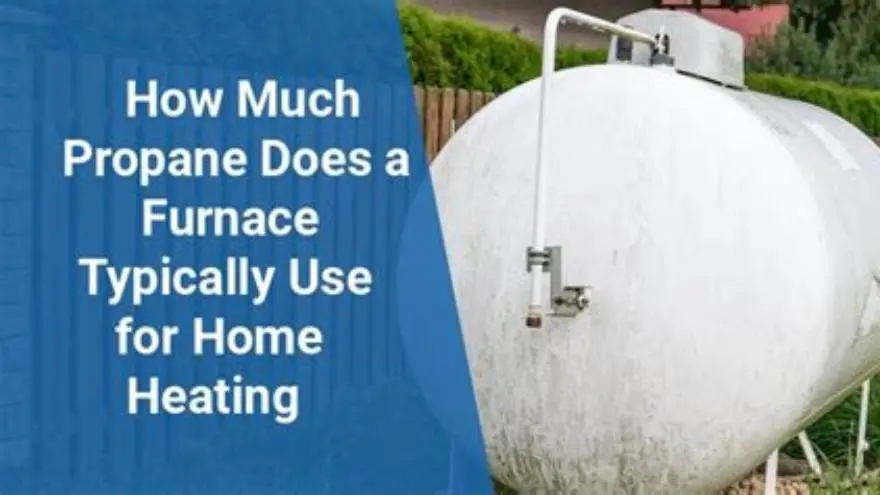
Part of the guide: Propane furnace efficiency: what 80% vs 96% AFUE means
Propane Facts
- Propane energy convention
- about 91,500 BTU per gallon
- 80,000 BTU input stage
- about 0.87 gal/h while operating
- Calculation
- input BTU/h ÷ 91,500
- Two-stage furnace
- calculate each listed input separately
- Tank gauge
- approximate liquid level percentage
Contents10 sections
- How much propane does a furnace use per hour?
- Which number on the furnace rating plate do you use?
- How do fixed, two-stage, and modulating burners change use?
- How do you measure real runtime and turn it into gallons?
- How do you check the estimate against your propane tank?
- What should you check if the numbers keep disagreeing?
- How does furnace efficiency affect propane use?
- Can thermostat setbacks reduce propane use?
- Key points
- People also ask
How much propane does a furnace use per hour?
A furnace uses propane according to its input rating and runtime. Use 91,500 BTU per gallon for a practical estimate. Delivery conditions and fuel quality can vary slightly, so the result isn't a meter reading.
Divide the input rating in BTU per hour by 91,500. An 80,000 BTU furnace uses about 0.87 gallons per hour while firing. A 40,000 BTU stage uses about 0.44 gallons per hour.
Those figures show the firing rate, not your home's average hourly use. Multiply each rate by the hours the furnace actually runs. A furnace operating half the hour uses roughly half its full-fire hourly amount.
| Input (BTU/h) | Gallons per hour while operating | Pounds per hour, approximate | Gallons in 24 hours if nonstop |
|---|---|---|---|
| 40,000 | 0.44 | 1.9 | 10.5 |
| 60,000 | 0.66 | 2.8 | 15.7 |
| 80,000 | 0.87 | 3.7 | 21.0 |
| 100,000 | 1.09 | 4.6 | 26.2 |
Which number on the furnace rating plate do you use?
Use the Input BTU/h value. Input describes the fuel energy entering the burner, while Output describes heat delivered by the furnace. The calculation uses input because propane consumption depends on the burner input and its operation.
A furnace can list one input, two fixed-stage inputs, or a range for modulating operation. Use every value the manufacturer provides. Do not replace a listed value with a percentage from another furnace.
A rating plate can list input in BTU per hour, but it does not authorize gas-pressure or burner adjustments. Actual pressure, orifice size, and burner operation must match the manufacturer's specifications. Only a qualified technician should test or adjust those parts.
- Turn the furnace off according to the manufacturer's instructions before opening any permitted access area.
- Follow the furnace manufacturer's instructions for accessing the rating plate; do not remove panels beyond what the manual permits.
- Find the Input BTU/h line on the plate or in the manual.
- Record every listed input for fixed, two-stage, or modulating operation.
- Photograph the plate, then reinstall any permitted panel exactly as the manual directs.
How do fixed, two-stage, and modulating burners change use?
A fixed-rate furnace has one listed input. Divide that input by 91,500 to estimate its fuel rate while firing. Average use still depends on how many hours the burner operates.
A two-stage furnace has separate low- and high-fire inputs. Calculate both from their own rating-plate values. Do not infer the low stage from a generic percentage of high fire.
A modulating furnace changes input across a manufacturer-specified range. Use the manual's input range or service information, then estimate each operating level only if the system reports those levels. A thermostat may not show every modulation step.
For example, a furnace listing 56,000 BTU low fire and 80,000 BTU high fire works out to about 0.61 gallons per hour on low and 0.87 on high. If runtime records show ten hours on low and two hours on high, multiply each rate by its matching hours, then add the results. The estimate is about 7.8 gallons for those twelve burner hours.
How do you measure real runtime and turn it into gallons?
Thermostat history can provide a useful runtime estimate. Check whether it records a call for heat, burner runtime, or blower runtime. Those measurements are not always the same, especially when the blower continues after the burner stops or the system uses separate controls.
A thermostat may report total heating runtime without separating low and high fire. A two-stage thermostat may show stages, but its display still depends on the equipment and wiring. Check the furnace manual before treating the displayed hours as exact burner time.
If your records show 9.5 hours in a 24-hour period, its average runtime share is about 40%. Use the applicable firing rate with those 9.5 hours. An 80,000 BTU stage operating for 9.5 hours would use about 8.3 gallons by this estimate.
Use stage-specific hours when the thermostat or control system provides them. If it does not, label the result as an estimate and compare it with delivery records. A short observation can miss cycles, so several days of records give a better picture.
- Record the thermostat's heating information and note what its runtime figure measures.
- Write down separate low- and high-stage hours when the system reports them.
- Record outdoor conditions and any other propane appliances using the same tank.
- Multiply each stage's input-based rate by its recorded hours.
- Add the stage results and compare the total with tank or delivery information over a longer interval.
How do you check the estimate against your propane tank?
A tank dial indicates approximate liquid level as a percentage of the tank's rated capacity. It does not measure gallons used with precision, and it does not show the exact amount available for every condition. Temperature, dial resolution, and float movement can affect the reading.
A 500-gallon tank commonly has a usable fill limit below its nominal capacity. A reading of 80 does not mean the tank contains 80 percent of 500 gallons in a precise, metered sense. Use the tank manufacturer's capacity information and treat the gauge as an approximation.
Read the same gauge at similar times, record the dates, and note any deliveries. Compare the change with your calculated use over a longer interval. Delivery tickets are better evidence when available because they record the gallons delivered.
For example, if your calculation predicts about 8.3 gallons per day and delivery records imply about 8.5, those estimates are close enough to be consistent, given gauge and runtime uncertainty. The dial is an approximate indicator, so do not treat a one- or two-point change as precise consumption data.
- Record the gauge percentage, date, time, and outdoor conditions.
- Note every delivery and save the delivery ticket.
- Include propane use from water heaters, ranges, fireplaces, dryers, generators, or other appliances.
- Use the same tank and compare records over a longer interval.
- Ask the supplier how its tank size and gauge markings should be interpreted.
What should you check if the numbers keep disagreeing?
Persistent differences need a process, not a guessed cutoff. Check thermostat runtime, stage information, other propane appliances, delivery records, and gauge uncertainty before assuming the furnace is overfiring.
Look for changes in operating conditions. A new thermostat schedule, colder weather, open windows, blocked filters, duct losses, or a new appliance can increase propane use without changing the furnace rating.
If the furnace was converted, serviced, or is showing abnormal operation, stop troubleshooting the gas train yourself and have a qualified technician inspect it. Do not adjust manifold pressure, replace orifices, or change controls based on an online calculation.
Yellow or unstable flames, soot, unusual noise, a fuel odor, or repeated shutdowns need professional attention. If you smell propane, leave the area and avoid switches, flames, and phones inside. Call the propane supplier or emergency services from outside.
- Check whether the thermostat records burner time, heat calls, or blower time.
- Check every appliance connected to the same propane tank.
- Compare calculated use with delivery tickets rather than relying on small gauge movements.
- Check the filter and visible duct condition without opening gas controls.
- Have a qualified technician inspect abnormal combustion, pressure, conversion, or burner operation.
How does furnace efficiency affect propane use?
Efficiency affects how much heat reaches the home from each gallon. It does not let you calculate burner input from the Output rating. Use the listed input for the firing-rate estimate.
A higher-efficiency furnace can deliver the same indoor heat with less fuel over time, assuming comparable sizing, duct condition, controls, and operating conditions. Actual savings depend on those factors and on how the furnace runs in your home.
Use the AFUE rating for seasonal comparisons, not as a substitute for the input value. Delivery records and weather-adjusted runtime show your home's result better than a nameplate calculation alone.
Can thermostat setbacks reduce propane use?
Usually, lowering the indoor temperature reduces heat loss while the home stays cooler. The furnace may run longer during recovery, but the recovery period does not automatically erase the earlier savings.
Your own runtime and delivery records provide the best answer. Compare similar weather periods, record the thermostat schedule, and include other propane appliances in the comparison.
Key points
- Read the Input BTU/h value on the rating plate or in the manual. Do not use the Output value.
- Use each listed input separately on fixed, two-stage, or modulating furnaces.
- Treat thermostat runtime as an estimate because it might show a heat call or blower operation, not exact burner-on time.
- Compare your calculation with tank readings over a longer interval, using delivery tickets when available.
- If the difference persists after checking runtime, other appliances, delivery records, and gauge uncertainty, ask a qualified technician to investigate.
People also ask
Does a high-efficiency furnace use less propane per hour?
Not necessarily while the burner operates. Compare the furnace's input rating and firing stage for the fuel rate. Higher efficiency can reduce seasonal fuel use because more of the fuel's heat reaches the home, but runtime and equipment operation still matter.
How do I estimate a heating-season total?
Record stage-specific runtime and propane deliveries through the season. Multiply each stage's input-based rate by its recorded hours, then compare the result with delivery tickets. Include other appliances using the same tank.
How much propane does a 20,000 BTU RV furnace use?
A 20,000 BTU input stage works out to about 0.22 gallons per hour while firing, using the practical 91,500 BTU-per-gallon convention. Actual cylinder life depends on burner runtime and the furnace's listed input.
Can I adjust gas pressure to make the calculation match?
No. Do not adjust gas pressure, burner controls, or orifices to match an estimate. Follow the furnace manual and have a qualified technician test operation against the manufacturer's specifications.