Propane fire pit on a 20 lb tank: hours = 430,000 ÷ burner BTU
About 6 to 14 hours on a full 20 lb tank at full flame, depending on the burner. A 20 lb tank holds roughly 430,000 BTU, so divide that by your burner's BTU/hr. A 50,000 BTU/hr burner gives about 8.6 hours.
Part of the guide: 20 lb propane tank on a grill: runtime by burner BTU
Propane Facts
- 20 lb tank energy
- about 430,000 BTU
- 100 lb cylinder energy
- about 2,160,000 BTU
- Energy per pound
- about 21,600 BTU
- 20 lb at 50,000 BTU/hr
- about 8.6 hours
- 100 lb at 50,000 BTU/hr
- about 43 hours
- Typical exchange fill
- often about 15 lb
- Propane boiling point
- -44 F
Contents8 sections
- How do you turn 430,000 BTU into hours for your burner?
- How long does a propane fire pit last on a 20 lb or 100 lb tank?
- Does turning the flame down stretch the run time?
- What do cold weather and a low tank do to the flame?
- How do you check what's left in the tank by weighing it?
- How do you track a tank hidden in a fire pit table, and does a swap tank start full?
- Key points
- People also ask
How do you turn 430,000 BTU into hours for your burner?
BTU stands for British thermal unit, a small packet of heat. Your burner's rating says how many it burns each hour at full flame. The tank holds a fixed number. So the sum is hours = 430,000 ÷ burner BTU/hr, and it works for any 20 lb tank on any burner.
The 430,000 comes from the tank. A 20 lb tank is filled to about 80% of its volume, which is about 4.7 gallons of liquid propane. Propane holds roughly 91,500 BTU per gallon, and 4.7 × 91,500 is about 430,000 BTU. Check it by weight: 20 lb × 21,600 BTU per pound is 432,000. Both land in the same place.
Now find your burner's number. Look for a metal plate or sticker near the gas inlet, on the burner pan, or inside the table's tank door. The manual lists it as the input rating in BTU/hr. Some list kilowatts, so multiply kW by 3,412. If the plate says "up to", use that figure, because it's the full-flame number. Two burners? Add them.
Can't find it? Search the model number plus "manual", or ask the maker. Don't guess from the flame. Take a phone photo of the plate now, so you have it when you're standing at the tank. For the detail, see our notes on does a 20 lb propane tank last.
How long does a propane fire pit last on a 20 lb or 100 lb tank?
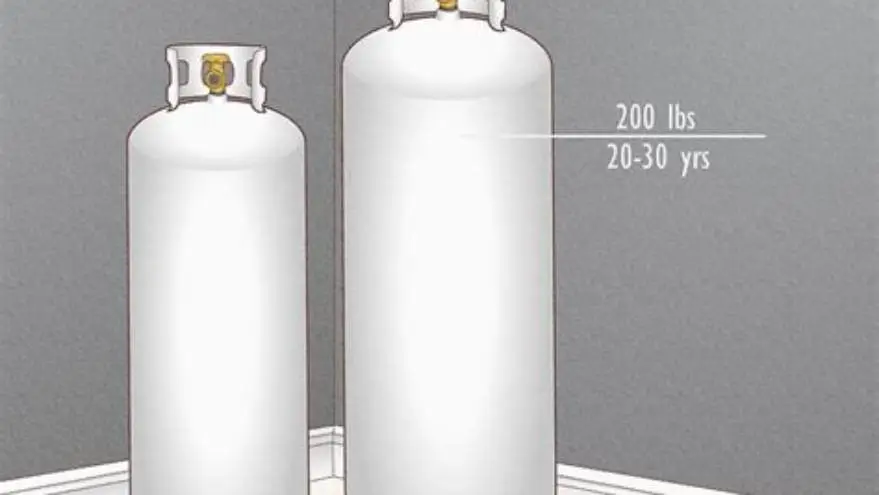
At full flame on a full tank, most fire pits run about 6 to 14 hours on a 20 lb tank. Your burner's rating decides where you land, so use the table. A 100 lb cylinder holds about 2,160,000 BTU (100 lb × 21,600), which is five times as much.
Here's a worked example. Your plate says 50,000 BTU/hr. For a 20 lb tank, 430,000 ÷ 50,000 = 8.6 hours. For a 100 lb cylinder, 2,160,000 ÷ 50,000 = 43.2 hours. At three hours an evening, that's just under three evenings from the small tank and about 14 from the big one.
Treat these as the ceiling. The table assumes a full tank at about 60 F with the flame wide open. Real runs come in lower, so I plan on 80-90% of the figure. That costs you a little optimism and saves you a dead burner at 10 p.m. The Tank Runtime Calculator on this site will do the sum for your own tank and burner. If that sounds like your situation, read up on low grill heat next.
| Burner rating (BTU/hr) | 20 lb tank (hours) | 100 lb cylinder (hours) |
|---|---|---|
| 30,000 | 14.3 | 72 |
| 40,000 | 10.8 | 54 |
| 50,000 | 8.6 | 43.2 |
| 65,000 | 6.6 | 33.2 |
| 80,000 | 5.4 | 27 |

Digital Hanging Luggage Scale with Comfortable Handle and Large Hook
Lets you check remaining propane by weighing the tank: it lifts 20 lb tanks and reads to 0.1 lb, so you can see how much is left.
Does turning the flame down stretch the run time?
Many people assume half flame gives double the hours. In practice the gas flow doesn't track what you see. Valve travel isn't proportional, a lava rock or glass bed hides the change in flame height, and a standing pilot, if yours has one, burns at every setting.
Burners differ, and manuals rarely give a low-setting figure. Some pits may fall to a third of their rating on low, others to half or more. You can measure yours in one evening.
Weigh the tank before and after a session at your usual setting (method in the next section). Say it lost 2.0 lb in 3 hours. That's 2.0 × 21,600 = 43,200 BTU, and 43,200 ÷ 3 = 14,400 BTU/hr. On a 50,000 BTU/hr pit, that's under a third of the rating. A 20 lb tank at that setting lasts 430,000 ÷ 14,400, or about 30 hours.
Use your measured number in the formula in place of the rating. One weigh-in beats any guess.
What do cold weather and a low tank do to the flame?
Propane burners run on vapor, not liquid. The liquid in the tank boils to make that vapor, and boiling pulls heat from the tank wall. Propane boils at -44 F, so cold alone won't stop it. A high draw in cold air does chill the tank, though, and the pressure drops with it.
You'll see a flame that shrinks, turns lazy and yellow, or fades as the evening goes on. Frost may form on the regulator or the lower half of the tank. A light frost at full flame is common. Heavy ice with a weak flame means the tank can't keep up.
When the tank runs low, it gets worse. Less liquid touches the wall, so there's less surface to draw heat from. The last quarter of a 20 lb tank is where a high-BTU burner struggles most on a cold night. A 100 lb cylinder has far more wall, so it holds up better.
What does that do to your hours? The fuel is still there, but you can't use all of it. Near freezing, with a 50,000 BTU/hr burner or bigger on a 20 lb tank, I'd plan on losing 10-25% of the table figure. That's my judgement, not a measured number. Wind, tank level and burner draw all move it. Turn the flame down to ease the load.
How do you check what's left in the tank by weighing it?
Weighing beats any gauge guess on a small tank, because propane weighs the same at any temperature. You need the tank's tare weight, which is its empty weight. It's stamped on the collar (the ring around the valve) as TW, often in the 16-18 lb range on a 20 lb tank. Read yours, since it varies by maker.
Any bathroom scale works if it reads to a pound or better. A hanging or luggage-style scale rated to 50 lb or more, reading to 0.5 lb or finer, is easier, since a full 20 lb tank weighs about 37 lb in total. For a 100 lb cylinder, use a bathroom scale rated for 300 lb and get help lifting.
- Turn the burner off and close the tank valve. Disconnect the hose as your manual directs.
- Read the TW number on the collar and write it down.
- Weigh the tank alone, with no hose or regulator.
- Subtract TW from the scale reading. The result is pounds of propane left.
- Multiply those pounds by 21,600 to get BTU left.
- Divide by your burner's BTU/hr (or your measured low-setting figure) to get hours.
How do you track a tank hidden in a fire pit table, and does a swap tank start full?
Inside a table cabinet, a tank is hard to read. You can't see it, lifting it is awkward, and a gauge fitted at the hose shows pressure, not fuel. Pressure follows temperature, not liquid level, so the needle looks fine until the tank is nearly dry.
Track hours instead. Tie a tag to the tank and write the fill date and starting fuel. Log each session's hours. Hours × burner BTU/hr ÷ 430,000 gives the share used. Example: three evenings of 2.5 hours at full flame on 50,000 BTU/hr is 7.5 hours. 7.5 × 50,000 = 375,000 BTU, or 87% of the tank. About 55,000 BTU remains, roughly an hour.
Swap-exchange tanks may not be full. Many cages fill to about 15 lb of propane rather than 20, and the label should say. Fifteen pounds is 324,000 BTU. On a 50,000 BTU/hr burner, that's 6.5 hours instead of 8.6. A station refill, filled to the tank's limit, gets you the full 430,000.
Keep the tank in the ventilated space your manual specifies. Never store a spare 20 lb tank indoors, in a garage or in a hot car. Weigh the tank before your next big evening and you'll know if you need the spare.
Key points
- Find the BTU/hr input rating on the burner plate or in the manual before you do any sum.
- Plan on 80-90% of the calculated hours. Cold air, a nearly empty tank and a part-filled exchange tank all cut the real figure.
- Flame height is a poor guide to gas use. Weigh the tank to learn what your low setting really burns.
- If the tank sits inside a table, log hours of use instead of trying to read a gauge.
People also ask
What if my fire pit has no BTU label at all?
Search the model number with the word manual, or contact the maker. Failing that, weigh the tank before and after a measured session. Pounds burned × 21,600 ÷ hours gives your real BTU/hr.
Will a 20 lb tank run a 65,000 BTU/hr pit in winter?
It can, but expect a shorter run than the 6.6 hours on paper, and a weaker flame late in the evening. A larger cylinder holds output better in cold. Run lower, or check how your pit behaves on a mild evening first.
Does a 100 lb cylinder last five times as long as a 20 lb tank?
On energy, yes: about 2,160,000 BTU against 430,000. It also holds output better in cold. Whether it saves money depends on your refill price per pound, which the Tank Runtime Calculator can help you compare.
How full is a 20 lb tank after a station refill?
A refill is usually filled to the tank's limit of about 80% of volume, near 20 lb of propane. That's the 430,000 BTU used here. Weigh it afterward and subtract TW if you want to confirm.